` seemed like it could be suitable for all of the app’s functionalities.
However, it took me a while to figure out how I could render the tag, which is a part of Electron’s API, into React’s DOM(and, therefore, as JSX). This issue, just like some of the others, only sped development time down, and made it unable to just build out the important features of the app, such as online action management.
3. **Main Functionality**
I knew what I wanted to make, but I kept striving for too much on my first build. I couldn’t stop adding new functionalities that I lost focus on the main purpose of the app: to help users keep actions online organized. So, instead of writing out this entire browser, I decided to get my ideas into the hands of the people and validate my value proposition.
From there on out, I decided that I would create a simple Chrome extension that allows users to manage what they’re working on by grouping related tabs together.
The rest of the extension’s development was rather easy. I removed extraneous features, including using standard React state and browser local storage instead of GunJS, and focused more on the logic of the app.
**So, what’s the point?**
Why am I telling you this story? Why did I waste my time on a project that I ended up scrapping? Why did I vie so hard to validate my value proposition?
Although there are many features of this idea that I would like to develop, the most important part of this product is user action. Unlike other services, which are built around a business(take Postmates or Uber, for example), this product is designed to make it easier for users to browse the web and keep their online lives organized.
The importance of this Chrome extension isn’t necessarily the functionality, but it is the user response. It is seeing how users use this product and learning how to adapt those patterns in a way that makes our standard GUI as responsive and straightforward as possible.
And although the final product turned out much different than the original idea, I feel like I’ve found a way to test my idea and use the experience to develop what’s next.

The official banner for my final product, Actions
Update: Actions is no longer available for download, as we are preparing for the launch of our flagship product in early 2020.
------------------------------------------------------------
## Internet Os - [/blog/internet-os](/blog/internet-os)
---
title: 'Internet OS'
publishedAt: '2023-03-09'
summary: 'How the Internet will become a part of the operating system and what that looks like.'
---
__How the Internet will become a part of the operating system and what that looks like.__
_For the first time I’m publishing a [video essay](https://www.youtube.com/watch?v=IpbvRUdLY_U) — it captures the essence of a talk I’ve been giving to many people about my views on the Internet and operating systems. Have any questions about the content or comments on the format? [Get in touch!](https://dylansteck.com/)_
Our menu bars are shrinking and **the browser is eating the desktop**. Instead of using apps in different windows, people use web apps in different browser tabs.
The operating system used to be the home for our digital lives — we cared deeply about how we styled the desktop, stored items in folders, chose our favorite apps, and became familiar with how system-wide functions worked. It may not have been a perfect set up, but everything you did existed in one place that you could make your own.
As our lives moved from the desktop to the Internet, the interfaces we used didn’t change to reflect this shift. People have no central identity or homepage on the Internet or in their browser that is the root of everything they do. It’s up to the individual to create their own workflows, which are often imperfect and require hacks. In addition, people have a hard time using multiple web apps because each app has its own set of rules and functions that it abides by, instead of system-wide controls that users can become familiar with and that let data from different apps interact.
I’ve always dreamed of a new operating system that treats Internet data as first-class citizens, the same way it does for files. What if the key elements and data on a webpage were apart of the operating system — something you can change and re-use? You can run any function globally on data matching a type, not the functions the app has for it(eg. all text have the same text functions, all spreadsheets have the same functions, all feed etc).
Imagine this operating system as a tool that gives you built-in read and write access to the Internet. Instead of us living our lives in multiple apps, we grab the data we need from different apps as part of the operating system and organize tasks or spaces we want to work in. We can define how we want data to look and what data we want, we can run controls or set rules because all of the rules are built directly into the operating system, and anyone can build on the data that exists without learning to code.
Not only could such native integrations make it easier for people to get things done, but it could also bring a new wave of personalization back to the Internet — something that’s been missing since at least the MySpace days. If we think about the Internet as a data source and the screen as a canvas that anyone can build on, even if you don’t know how to code, then anyone can build anything and express themselves however you want. What we use “on the Internet” can be much more specific to our needs, and much more expressive of our beliefs and aspirations.
Want to talk about the next Internet OS or help me build it? Drop me a line!
------------------------------------------------------------
## Its Time To Rebuild The Internet - [/blog/its-time-to-rebuild-the-internet](/blog/its-time-to-rebuild-the-internet)
---
title: 'It’s Time to Rebuild the Internet'
publishedAt: '2019-07-11'
summary: 'It’s Time to Rebuild the Internet'
---
_I’m trying to change the way we interact with our screens. But first, a little history:_
Over the past fifty-odd years, human interaction with technology has rapidly increased. The term “technology” itself, which used to be synonymous with the innovations that made production faster and more efficient, has started to refer more generally to the computer screens that have more and more commanded our attention since the “dot.com” fever of the late 1990s. Introduced commercially in the 1980s, computers were seen as methods to efficiently do work (ex. Apple’s real breakthrough with the Macintosh was effectively to replace the typewriter with its word processor) and foster new experiments via the nascent Internet as well as video gaming.

As computers became increasingly commercial and gateways to new markets, the Internet gave humans a new (and instantaneous) way to connect with one another as well as with information. Next, mobile phones started to emerge, adding to an age of ever-evolving technology. With these new tools at the world’s disposal, late 20th/early 21st century humanity became the most connected, and interconnected, population ever.
However, with the rapid expansion of new products and related services came a slew of privacy and protocol issues that were largely unforeseen. For example, while the rise of social networking helped people connect with one another, a few “unicorns”, such as Facebook, suddenly had access to, and control of, an enormous amount of user data. While certain regulatory groups, such as the World Wide Web Consortium (W3C)and the European Union’s GDPR, attempted to govern the internet, the “World-Wide-Web” is still a relatively unregulated territory. Anybody can buy a domain and upload any content. With enough skill, passion, and determination, any kid in a garage can create a billion dollar company. Any company can control and sell your personal data.
No doubt powerful and transformative, the Internet nonetheless has spawned a slew of privacy, misinformation, and monopolistic issues that leave it at a vexing crossroad. Here are a few major issues that I feel most urgently need to be addressed:
1. **Personalization**
When a user goes online(through a browser or an app), they are presented with a plethora of different options. The user knows that their work files are stored in Google Drive, their work conversations are in Slack, research in JSTOR, wish lists on Amazon, so on and so forth. While the user might understand which site serves which purpose and where they need to go in order to get certain tasks done, the path the user has to take in order to interact with multiple different interfaces can be confusing. Little does the user’s Google Drive account know that the actual research being done for work that’s stored in one folder is being done on another website.
So, not only does the user have to continually work to find the content that they want, but each piece of data that they search for lives and operates within its own environment. The lack of personalization and direction given to the user can make it too confusing not only to do the simplest tasks, but to interact with their content how they’re supposed to. What if the user had an easier way to view all of their content, no matter where it’s coming from? What if the user operated within an interface that was designed to help them get tasks done? Computers are supposed to help make it easier for users to get tasks done and keep track of/create content, however it feels as if they keep unintentionally getting in the user’s way. If we start to redesign and combine the interfaces in which users interact with their devices(primarily connecting to the internet), then we can work towards making these interfaces more _humane_.
2. **Security**
Over the past decade, everyday life has become more and more reliant on technology. All of our vital information — from medical records to work files to conservations with loved ones — increasingly happen- and are stored- online. However, users have become unwittingly dependent on tech/social media corporations, such as Facebook and Google, to properly and safely manage their data. While hundreds of millions have come to rely on a handful of mega-providers, showing how powerful they are and how integral they’ve become in everyday life, centralizing and controlling (IE _owning_)a user’s content is not only a _security_ flaw but a _design_ flaw in the system
In terms of security, having everyone’s data stored in one place by one company makes that company a prime target for data theft, degradation, and other types of attack. It limits how much control the user has over their own data. While most people don’t have the expertise or desire to set up, host, and maintain their own personal servers/databases, everyone wants some level of assurance that their data won’t be lost, compromised, or stolen. From a design standpoint, individuals are left with the only option that all of their data for one account resides in one place, while the data from another account resides elsewhere. Optimally, each person should/would be able to use and edit their own content via one interface, anywhere and anytime.
Done properly, this could give the user more control over their personal content while minimizing the risk of getting hacked. It would be necessary that the user’s data be under their control per se; more likely the data just wouldn’t be on their own desktop or private server. Some new configuration, for example, a peer-to-peer blockchain network, would be the likely solution.)
3. **Responsiveness**
The internet is an endless repository of content, yet the way most of us interact with it is very two-dimensional. Search engines are set up to read your query and feed back a list of responses. Browser history is really just a list of sites you viewed, at one time. None of this data is set up dynamically: _when_ you viewed it, _what type_ of content it is, and in _what context_ you searched something **matters**. We need to incorporate this type of intelligence into how the user finds and uses content. A true humane interface, the type of system we should be building, makes it easy for the user to complete simple tasks and _responds_ to their behavior. In my view, your browser/desktop/“front-end” needs to start responding to all of this data — YOUR data — and making it truly useful for you.
At present, this might be the way someone opens tabs on their browser to start their work day: the user opens Gmail in one tab, Google Drive in another, searches for Trello in the next, and continues on a topic of research from the prior day. The user’s activity is already being tracked by their browser, ISP, and search engine. Why can’t their usage and trends get tracked to better enhance their personal workflow? For example, suppose that before an individual initially used the internet they first had to create an account that would log them into any website, store all of their personal data(passwords, work files, browsing history, bookmarked sites, social media accounts, etc.) and track the way that they used the web.
Instead of the user using a linear search(query-based) to find content, the browser could recommend that the user open a certain workspace (based on past usage and/or learned personal preferences) or suggest that the user goes to ‘x’ website that is in line with the research that they were doing some other day. We’ve seen artificial intelligence enhance user-flow, most notably through IoT devices(such as Amazon Echo) and mobile devices. Why can’t a similar standard be developed for internet usage across platforms? Why can’t there exist a truly personalized front-end that is unique to each user?
— — — — — —
Given how developed the internet already is, changing the interface from the ground up presents many new challenges and has to be done carefully. First, an interface needs to be researched and designed in order to give users the most humane experience possible — responding to their actions and making it easy to get tasks done without getting in their way. In addition, we need to make sure that we work in accordance with others on the internet in order to build an interface that can work with everyone. This includes working to change how data is stored and how current internet protocols work.
While we have larger aspirations at Stecknologies, reworking this sector of the internet is important not only for our future development, but also to ensure that developers and users alike have a more powerful and safe playing field, especially given the economic growth that the Internet can stimulate. Here’s how we’re going to help:
**1. We’re building a new browser that tracks the user’s workflow.**
Our journey is a long one, but we need to fight each battle one at a time. We not only want to increase the technology that we and others in the developer community can use, but we want to launch products that can instantly positively affect the daily lives of users. While still holding true to the core ideals of improving personalization, security, and responsiveness, we are building a browser that tracks the user’s workflow. Here are a few key features:
- No tabs — flows are created around particular tasks that you do in your browser. As you create new actions, sites and files that are related are added to similar flows centered around actions. This makes it easier to track your work and gives the user a less cluttered screen.
- When the user starts a new action, the browser tracks their ‘flow’ — the progression of sites that they use and the importance of each site — and saves it to a workspace. Users can also upload important files and documents to ensure that all of their content for one topic lives in one place
- After the user has gotten familiar with their workspace, the browser starts to give the user analytics — how much time they spend per workspace, what sorts of sites they use when, and what sorts of things they might want to try searching
- User content is stored in a decentralized account powered by blockchain technology
**2. We’re planning to build a new operating system.**
As we work towards reworking the building blocks of the internet, we want to build components that are helpful on their own, but can come together to make a larger, more powerful(and humane) interface. The operating system is the driver of the device — yes, it runs many programs that the user will never interact with, but it also controls the interface that the user is presented with from the ground up. It is important to add these core concepts of personalization, security, and responsiveness to the operating system for many reasons. Here are just a few:
- It will make it easier to transport user data across interfaces, whether it’s a mobile device, laptop, IoT device, or even broader, less personal network
- It will incorporate modern design practices into the operating system and remove a layer of inconsistent styling, further slowing the user down
- It will redesign software whose GUI has been rooted in the same principles for 20+ years
- It will make it easier to let developers edit parts of the OS that had been rather untouched for a very long time
**3. We’re calling out to the community to help.**
There are many communities that are also working towards building a better internet. For example, both Blockstack and Solid(which was founded by the creator of the Internet, Sir Tim Berners-Lee) are working towards creating frameworks that empower developers to build decentralized apps. In addition, the W3C(World Wide Web Consortium) and Mozilla, creators of the popular browser Firefox, publish reports and hold conferences on improving the health of the internet.
In the space of productivity and workflow efficiency, multiple tools, such as Dropbox’s latest workspace update and Notion, are working towards making it easier for users to find and edit their content.
While we are actively observing activities in these communities and looking for ways to contribute, we would love to connect with anyone who wants to chat or help us get closer to achieving our mission of creating a universal, humane interface.
------------------------------------------------------------
## Lego Blocks For The Web - [/blog/lego-blocks-for-the-web](/blog/lego-blocks-for-the-web)
---
title: 'LEGO Blocks for the Web'
publishedAt: '2022-12-15'
summary: 'LEGO Blocks for the Web'
---
The structure of the Internet is like the Wild West — each app has its own set of standards that users need to familiarize themselves with. The rules and data in these apps hardly overlap with other apps, and so users are left with a fragmented Internet life, while app developers are stuck trying to make their own mega-systems to fend off competitors.
Computing wasn’t always this way. Take the local file system, a paradigm people use to live their lives off of, for example: all files have the same functions, as well as the option to be opened in a client of the user’s choice. Although each file has its own use case, users felt a level of familiarity with what they could do with a file, and some files could be used/attached in several desktop applications. As the Internet pushed more content off of the desktop and into the browser, app structure left the constraints of the window/the desktop’s toolkit for the web, where developers had total customization over app constraints.
Computing wasn’t _supposed_ to be this way either. While laying out his plan for the Internet, Sir Tim Berners-Lee harped on a concept called [“linked data”](https://www.w3.org/DesignIssues/LinkedData.html), also referred to as The Semantic Web or Web 3.0(long before the crypto industry adopted the term). The concept of linked data, which Berners-Lee is [still advocating for today](https://www.cnbc.com/2022/11/04/web-inventor-tim-berners-lee-wants-us-to-ignore-web3.html) with his company [Inrupt](https://www.inrupt.com/), refers to structuring data in a way that has semantic meaning and creates direct links between web documents, forming an Internet of linked documents. In the context of the image below, knowledge about the Mona Lisa can be used to not only find more Mona Lisa information, but specifically more information about other paintings by da Vinci, or other things that Bob is interested in.

Despite the creation of several linked data formats and query languages by the World Wide Web Consortium(W3C), such as RDF, SPARQL, and JSON-LD, as well as several commercial efforts, the true essence of linked data never quite took off. However, some of its concepts were used in ways not often publicized, such as the Open Graph standard allowing for link previews and JSON-LD powering rich AMP results that show up in Google.
Over the past two decades, the Internet saw an unprecedented explosion, where companies and the modern consumer shifted lots of their attention and daily ongoings to the web. During this time, companies set off to take the standards built by W3C and remix them to build all-encompassing platforms that they hoped would capture the user’s attention. Companies weren’t just focused on capturing an internet market anymore, they wanted to own it — even if that meant exploiting user experience tactics to make money on personal data. Tools that started off a single utility, such as Google, quickly expanded into several web-native domains in an attempt to build a suite of apps that the user couldn’t live their life without. And so, the architecture of the web is currently a bunch of different, barely-compatible systems held together by duct tape and baling wire, instead of a solid, coherent platform.
By the mid 2010s or so, [more than 80% of American adults](https://www.pewresearch.org/internet/2015/06/26/americans-internet-access-2000-2015/) were already using the Internet, the term “big data” was starting to take shape, and information overload was beginning to set in. With the amount of information coming in, it became seemingly more difficult to find and organize the right content in a clutter-free manner. Users began looking for ways to have their own homebase on the internet so they could keep track of their digital lives.
Productivity tools began branding themselves as “workspaces” — all-in-one apps that had note-taking features, spreadsheets, folders, and more, almost creating a virtual desktop. While the structure of these workspaces later led to competition over features and content syncing, the general concept of workspaces became popular and people liked being able to control their own corner of the Internet.
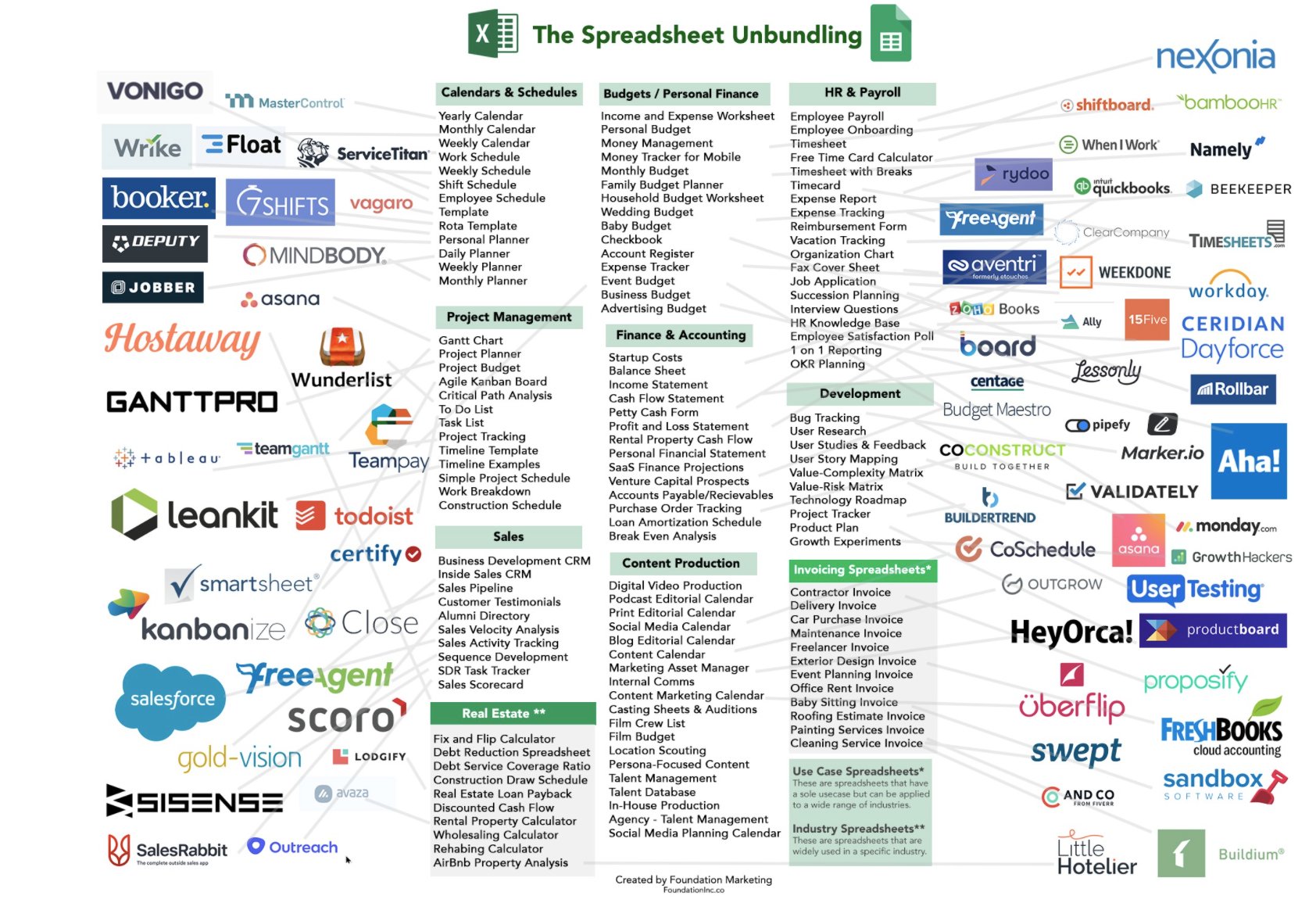
As productivity tools rose to more mainstream notoriety, a new wave of tools emerged that focused on building easier-to-use spreadsheets. These spreadsheets could be for simple online collaboration or could be used to create entire demo apps, as a tool like [Airtable](https://airtable.com/) could be used for. This began "The Spreadsheet Unbundling" -- the rise of several productivity apps that, whether for a small niche or general purpose, leveraged the programmability of spreadsheets and their cells to give the users more flexibility over their datasets.
Along with the spreadsheet unbundling, a note-taking tool that was inspired by spreadsheets hit the market and changed how many people think about staying productive. This tool, [Roam Research](https://roamresearch.com/) is an outliner-based note taking tool that has its own tagging system that connects topics. Because Roam is outliner-based, that means every page only has bullet points, and each bullet point is referencable, just like a cell in a spreadsheet. While the syntax of the app can be a bit confusing for the average user and a bit difficult to maintain even for a power user, the ability for users to "program their notes" offered a new set of possibilities, such as building personal CRMs, studying for tests, or building a knowledge base for a team.
Although they are annoying to organize and maintain, these outliner tools attempt to create a state that user’s don’t often have access to, and creating an outline can be helpful in certain scenarios. However, a perfect outline is often only a proxy for input, not a perfect structure with which we want to perform all of our tasks. On top of this, outliner tools(Roam especially) only work for part of a user's workflow and don't always properly fit into the rest of the user's workflow.
What users really want instead of some "perfect structure" is the ability to make sense, which is why outliners are popular in the first place. However, it is imperative to find a middle ground where the structure is a proxy for input and the focus is on amplifying the sense-making process, so users have more customization. What if we could think about the Internet as a data source that we can draw upon to take actions we want to, and the computer as the agent that guides us on our journey there? What if users had a set of LEGO-like blocks they could use to customize the data they want to access, view that data in any format they want, and share with anyone they want?
[https://twitter.com/azlenelza/status/1572730650830209025](https://twitter.com/azlenelza/status/1572730650830209025)
Imagine a browser that organizes all of your tasks in one place -- from reviewing your inbox to working on a multi-day demo process to keeping up with the World Cup. No more needing to log the day’s events or to search for a task’s resources.

As you settle into a space and start exploring, you can separate different trails of search that you go down, even if they stem from the same source. That way you can keep a collection of related content together, while also allowing for serendipitous exploration.

What if the information from these sources already had a shape that users could interact with? In the example below, the user can type an action they want to take with natural text, but also use the UI to take actions such as changing the view type or duplicating the block. The shape of the data could also be further shown with some sort of virtual Finder, showing not only all of the user’s data across the Internet but also the actions they can take with that data.

In a world where the shape of data is pre-defined and users don’t need to program complex functions to transform the data, the user can create plug-and-play interfaces for their own needs. A researcher can build a workspace that connects their notes to citations in a final paper. A project manager can create workflows to automate daily reports and build dashboards pulling live metrics from different projects. A student running a school club can program an admin dashboard to organize all of its members. The interfaces and tools individuals build could result in community marketplaces or social graphs -- the possibilities are endless.
It’s exciting to think about what a new computing environment could look like where the user has more control and can construct their digital lives as if they were an app developer. We have been making small tweaks to the same paradigms for decades and I think giving users a set of tools that feel native no matter what they do will further accelerate what people can do with the Internet. I also think it can help people better explore content with the help of their computer, making it easier to focus on content and not how to find it. AI advancements further those exploration efforts even more, with software like [ChatGPT](https://chat.openai.com/) being able to provide information in different formats at the user’s request. One could imagine the AI as an assistive agent, with it being able to answer questions, to perform tasks, or to help go down rabbit holes.
As we enter this new age of the Internet, it's clear that users are looking for more control over their online experiences. With the potential of LEGO blocks for the web, users can have the ability to create, edit, and share their own experience without the limitations of current systems. Whether this idea will become a reality remains to be seen, but it is certain that the Internet is moving towards a future where users are firmly in the driver's seat.
------------------------------------------------------------
## My Summer At Chapter One - [/blog/my-summer-at-chapter-one](/blog/my-summer-at-chapter-one)
---
title: 'My Summer at Chapter One'
publishedAt: '2022-09-12'
summary: 'My Summer at Chapter One'
---
**I cannot believe my time at Chapter One came to a close. I want to take a moment to reflect on this experience, the amazing teammates I interacted with, and my takeaways.**
## Setting the Vibe for the Summer
In June, I started as a [Studios](https://studios.chapterone.com/) intern. As soon as I saw the [Mirror post](https://mirror.xyz/chapterone.eth/PFf_-8totoqVyU2aKCS08Z-1bxPH73tIyXFyzkBWDIY) a few weeks prior, I knew this was an opportunity I couldn’t miss out on. I had known about [Jeff](https://twitter.com/jmj) and the team for quite a while and became even more excited as I got to know [Maria](https://twitter.com/mtangarova2) and [Mene](https://twitter.com/menemazarakis) throughout the interview process.
Before the internship started, I got the chance to lay a good bit of how I envisioned the summer could go. This not only set a great baseline we used to craft our roadmap, but it also helped me hone in on how [Chapter One](https://twitter.com/ChapterOne) operated and how I could best fit within their pre-existing structure.
Although I already knew about Chapter One and their mission a good bit, the team’s function and energy immediately stood out once I started. Everyone was so inspired and connected, very akin to the web3 spirit; on top of that, the way that everyone thought about even the smallest tasks as “shipping” made the team feel much more like a startup than a venture firm. Setting the vibe for the summer not only taught me a ton from a product perspective, but it also helped me better understand how I could fit within Chapter One.
## Studios
Working alongside one of our incubation companies within Studios was a super-hands-on process. From our first call, everyone on our team was asking questions across the stack, and the founders had tons of ideas and energy. It was amazing to chat in so much depth on a regular basis, from weekly calls to Telegram chats to impromptu Zooms.
Where I really gained the most insight was working on both sides of the startup-VC equation. On one hand, I was able to learn the needs of a founder or venture partner. On the other hand, I saw how those needs translated into solutions that best served everyone.

A great example of this on the founder side is the Ecosystem Landscape that I mapped out. [Yash](https://twitter.com/yb_effect) was instrumental in helping me craft my market research for the landscape in this process. He helped me learn how to structure the landscape, as well as exposed me to segments of the market I hadn’t explored in as much depth.
I also helped build some of the Studios infrastructure, based on our inaugural founding team’s needs by designing resources that other future teams will be able to leverage. Some of the work I did was around data centralization and documentation.
## The Value of Founder Experience
At Chapter One, everything is Founder Experience, and during my time with the team it became even more clear how important being a day-to-day partner to your founders is. By building the fund to support founders on all fronts within Talent, Community, Data, Research, Product, Design, and more, Chapter One is redefining Venture Capital to Venture Contribution. Spending time building under founder experience exposed me to many of the product verticals. I spent some time supporting the infrastructure of what we liked to call the Founder Experience machine. I also learned how to effectively and efficiently manage products while meeting stakeholders’ needs. I was lucky enough to be taught by the Founder Experience 🐐 herself, [Maria](https://twitter.com/mtangarova2)
## Moonshot Week
Moonshot Week was our internal hackathon, which was held in the middle of July. The team’s innovation and fast shipping was mind-blowing. Team members picked up new coding languages, published extensive research, and shipped new products— all in the course of five days. The best part was that the energy continued after Moonshot Week, most notably with the launch of the Chapter One Research Program, led by [Yash](https://twitter.com/yb_effect).
## Lessons from the Journey
This summer was a learning experience that I will never forget. This internship exposed me to so many new ideas and people in ways that broadened my perspective. I was able to meet tons of people from Studios and in the greater web3 space. I learned how to better think in frameworks, from focusing on first principles to being your own PM to getting to PMF. Having time to work in these frameworks and see how battle-tested they were improved my skills as a builder.
Understanding two key themes stuck out to me throughout the summer and I will carry these with me throughout my career:
1. Listening to Stakeholders
I found out how important it was to think about how the work being done could best fit into others’ lives. This helped make projects have more impact and also helped me learn how I can use other perspectives to organize a project. It’s a theme that stuck out across all of the work I did, no matter the vertical.
2. Lift-To-Launch
I also realized the importance of learning how to make the most out of the least amount of resources. This gave me a more realistic perspective on how things get done and forced me to pivot ideas and skills into areas that could be more quickly leveraged.
## Special Thanks to Maria
I couldn’t cap off my recap and insights without giving a big thank you to [Maria](https://twitter.com/mtangarova2), who taught me the ropes and impacts so much of the founder experience. It was amazing to see how much she cares about her work, makes the most of resources around her, and helps others. I learned so much from her and will never forget the lessons that I learned throughout this experience.
------------------------------------------------------------
## Next In Tech Apr 1 2023 - [/blog/next-in-tech-apr-1-2023](/blog/next-in-tech-apr-1-2023)
---
title: 'Next in Tech - Apr. 1, 2023'
publishedAt: '2023-04-01'
summary: 'Next in Tech - Apr. 1, 2023'
---
In this week's Next in Tech, Arc has released a mobile companion, Farcaster has 10 hubs running on its testnet, Twitter open-sourced its algorithm, and Elon Musk and other prominent figures have signed an open letter calling for a pause in the training of AI systems more powerful than GPT-4.
## Arc’s Mobile Companion is Here
[The Browser Company](https://thebrowser.company/) has released a mobile companion to their desktop browser, [Arc](https://arc.net). Arc's mobile companion app, internally called Archie, is an app that does more than what meets the eye. Despite not being a traditional web browser, Archie acts as a companion that can navigate and save content in an easy and fun way. This feature alone is what Arc members wanted, according to a survey conducted by the company.
Upon logging in, the app connects to Arc on desktop and populates with the user’s spaces. Each space can have its own background color, bookmarks and folders. The app also has a "Recents" area that shows the last few tabs opened across spaces. While Archie's functionality is minimal, it is quite powerful, especially as a save for later tool. It is shockingly difficult to move web pages between phones and PCs, but the synced sidebar makes this process easy. Users can look up a recipe on Google on their MacBook and pin it to their sidebar, which immediately shows up on their phone(or vice versa).
https://twitter.com/joshm/status/1641440894409908227
Arc's development team envisions creating an operating system for the internet that changes how users interact with apps and content online. Because of this, the company is not interested in building another web browser; instead of building a browser for mobile, they built a more powerful companion app for saving and launching content. While the app is currently only available on iOS, it is evident that the team is working to make it available on other platforms as well. Although Arc’s mobile companion isn’t a traditional web browser, it has the potential to fill an important gap in users’ browsing workflow.
## Farcaster Hubs Running on Testnet
Farcaster’s testnet now has 10 hubs running on it, a huge milestone that pushes the protocol closer to credible neutrality. The hubs are being run by core ecosystem developers who are testing and building on the protocol. In addition, [the first cast was sent directly from a hub as opposed to the Warpcast API on Wednesday](https://warpcast.com/dwr/0x36367c). Farcaster currently has 32 open source contributors to [its hubs repository on GitHub](https://github.com/farcasterxyz/hub-monorepo).
https://twitter.com/dwr/status/1641490535625158656
The future of hubs is exciting. As they take off, it will mean that developers can read and write from the protocol without going through the [main client’s API](https://warpcast.notion.site/Merkle-v2-API-Documentation-c19a9494383a4ce0bd28db6d44d99ea8). Different clients could run their own hubs, and so could developers. Hubs will allow for more flexibility and decentralization in the Farcaster ecosystem. As more hubs are added to the network, Farcaster's decentralization and resilience will increase, making it a more robust and secure platform to build social applications on top of.
## Twitter Open Sources its Algorithm
[Twitter open sourced it recommendation algorithm](https://github.com/twitter/the-algorithm/) yesterday, a highly anticipated move. This is something new owner Elon Musk has been talking about wanting to do for a while, as many previous discussions(especially during the Twitter Files) highlighted certain flaws in the algorithm. Although Musk prefaced that many parts of the algorithm still needed to be changed as it was released, several people have already started digging into the repository’s code. In fact, it already has 132 issues and pull requests.

Twitter Engineering explains the algorithm at a high level [in a new blog post](https://blog.twitter.com/engineering/en_us/topics/open-source/2023/twitter-recommendation-algorithm). The algorithm relies on a set of core models and features that extract latent information from tweet, user, and engagement data. The recommendation pipeline is made up of three main stages, including candidate sourcing, ranking, and applying heuristics and filters. This also includes a concept called Embedding Spaces, which work to cluster communities of related people around celebrities or users with larger followings. Ultimately, the goal of Twitter's recommendation system is to provide users with the best content possible, and the company is continually working on new developments to expand its recommendation systems.

One thing that many on social media were quick to pick up on was that [code in the algorithm](https://github.com/twitter/the-algorithm/blob/7f90d0ca342b928b479b512ec51ac2c3821f5922/home-mixer/server/src/main/scala/com/twitter/home_mixer/functional_component/decorator/HomeTweetTypePredicates.scala#L224-L247) specifically grouped users into four buckets: Elon Musk, power users, Democrats and Republicans. The idea of this type of grouping existing in the algorithm alarmed many, even after core engineers explained [in a Twitter Space](https://twitter.com/elonmusk/status/1641880448061120513) that the grouping wasn’t a part of the algorithm, but was implemented as a statistics measure to make sure their anti-grouping tactics were working.
## AI Pause Letter
Elon Musk, Tristan Harris from the Center for Humane Technology, Steve Wozniak, Andrew Yang, and 2,400+ others [signed an open letter](https://futureoflife.org/open-letter/pause-giant-ai-experiments/) with an aim to “call on all AI labs to immediately pause for at least 6 months the training of AI systems more powerful than GPT-4”. This letter comes during an era of unprecedented AI advancements, and only two weeks after OpenAI released GPT-4.
A powerful excerpt from the letter reads: “Contemporary AI systems are now becoming human-competitive at general tasks, and we must ask ourselves: _Should_ we let machines flood our information channels with propaganda and untruth?… Powerful AI systems should be developed only once we are confident that their effects will be positive and their risks will be manageable.”

In response, it seems as though the rest of the AI world is moving ahead. One user on Farcaster [@vgr even said](https://warpcast.com/vgr/0x6089f3), “Not that anyone cares what I think either, but I’d sign the opposite of this letter”. Additionally, [Sam Altman’s interview with Lex Fridman](https://www.youtube.com/watch?v=L_Guz73e6fw&t=34s) gave hints that Sam believed they were handling the speed and procedures of AI development properly. This letter comes during a time of heightened AI scrutiny, as [Italy just became one of the first countries to ban ChatGPT nationwide](https://www.bbc.com/news/technology-65139406) over privacy concerns.
## Top Links
_Interesting finds I’ve stumbled upon recently:_
- [ConjureUI - generate UI on the fly in a chat environment](https://twitter.com/sgrove/status/1640417065650778113)
- [Teaching GPT-4 to browse the web](https://twitter.com/m1guelpf/status/1640020967442227200)
- [gpt4all: a chatbot trained on a massive collection of clean assistant data](https://github.com/nomic-ai/gpt4all)
- [Look Again - Daily Visual Puzzle](https://lookaga.in/)
- [The Age of the App is Over](https://browsercompany.substack.com/p/the-age-of-the-app-is-over)
- [Your personal design language](https://www.proofofconcept.pub/p/your-personal-design-language)
- [State of Web3 Security: Part 1, Attacks](https://blog.stelolabs.com/state-of-web3-security-part-1/)
------------------------------------------------------------
## Next In Tech Apr 8 2023 - [/blog/next-in-tech-apr-8-2023](/blog/next-in-tech-apr-8-2023)
---
title: 'Next in Tech - Apr. 8, 2023'
publishedAt: '2023-04-08'
summary: 'Next in Tech - Apr. 8, 2023'
---
_Check out the piece and_ [_accompanying free launch NFT_](https://www.launchcaster.xyz/x/farcaster/642c8e0f72311cfd1f49a920) _I shipped earlier this week about_ [_product launch NFTs_](https://dylsteck.substack.com/p/product-launch-nfts)_!_
Apple’s preparing to launch headsets, Twitter and Substack are at odds yet again, and Farcaster’s ecosystem and protocol are seeing some exciting new changes on this week’s Next in Tech:
## Apple Headsets

Apple recently unveiled that [WWDC 2023](https://developer.apple.com/wwdc23/), their annual developer conference where they’re rumored to be unveiling a mixed reality headset, will take place on June 5th. In a Bloomberg [article covering this unreleased product](https://www.bloomberg.com/news/newsletters/2023-04-02/when-is-apple-aapl-announcing-its-mixed-reality-headset-june-5-at-wwdc-2023-lfzggfhe?sref=HrWXCALa), they explain that it’s a risky but potentially groundbreaking move for Apple, heralding mixed reality as its next major product category. At the conference, Apple is expected to showcase the headset, its xrOS operating system, as well as a software development kit and platform for developers to write new types of apps.
The conference will likely include a keynote presentation from the Apple Park campus streamed online, followed by hands-on time afterward at the headquarters. The headset launch could potentially change the way people interact with the world, offering a glimpse into the future where people interact with headsets instead of touch screens.
## Twitter vs. Substack

Substack and Twitter have been at odds this week, causing yet another stir in online communities.
First, early this week Substack launched a feature called [Notes](https://on.substack.com/p/introducing-notes?r=1ie15&utm_campaign=post&utm_medium=web), which is their own version of short-form content like a tweet. It lets anyone on the platform leave comments or even share snippets of articles, which could work well given the platform has 35 million subscriptions and is becoming more popular than ever.
Second and more importantly, Twitter began flagging and blocking Substack links in an effort to support content creation directly on the platform. It also [shows users with Substack links in their bios as blocked](https://www.theverge.com/2023/4/7/23674936/twitter-marking-substack-links-unsafe). This seems to be both a response to the Notes feature and a statement by Musk on his feelings about the platform, which seems to go against his vision for Twitter as an open digital town square. Sharing links is one of the most important things being done on the Internet, especially on Twitter, and so it would be a shock to see the platform take an even more hostile stance to external content.
## Farcaster Corner
It’s been a fast-paced few weeks on Farcaster and so it only makes sense to have a Farcaster corner this week.
Jam released major updates to their mobile client that make it have feature parity with Warpcast. It also features the new sign-in mechanism, which routes users back to Warpcast to approve Jam as a signer, as opposed to making users import their seed phrase. In addition, Jam announced a feature called longcasts — expanding the cast length for users and storing the data on their own. It’s exciting to see a team shipping at such a fast pace and presenting cool new features.
Additionally, Farcaster co-founders Dan Romero and Varun Srinivasan held a Clubhouse room on Thursday. A topic that was highlighted in the space that I found particularly interesting was the idea of embeds, something [I also touched on in a Farcaster post](https://warpcast.com/dylsteck/0xb03ef3).
From what I heard in the Clubhouse room last night, each cast has two embeds at the protocol-level. Soon we'll see more native embeds that can let clients show more rich data. eg. instead of an OpenSea link for a NFT, you input the contract address/token ID/chain ID and the client can present a lot more info.
Another use-case that Dan mentioned -- which was timely bc/ of the new longcast feature by Jam -- is having a client quickly render long-form content from Jam/Paragraph/Arweave/etc in an instant, kinda like the instant reader view in Telegram Dan said Google AMP had hoped to be that snappy but they never got there.
Some other examples of embeds that [Merkle team member Paul Fletcher-Hill](https://warpcast.com/pfh) touched on in GitHub discussions are YouTube videos, news articles, and casts.

What excites me even more is embeds enabling interactions across Farcaster-integrated apps. What if you could watch an [Unlonely](https://warpcast.com/unlonely) clip or RSVP for a stream directly from Warpcast? Or if you could see a graph with data generated from [farcaster.network](http://farcaster.network/) directly in a cast as an embed? There are infinite possibilities.
## Top Links
_Interesting finds I’ve stumbled upon recently:_
- [Support arbitrary targets for embeds, parents, and reactions](https://github.com/farcasterxyz/protocol/discussions/71)
- [A new NFT launch strategy: The wave mint](https://a16zcrypto.com/content/article/a-new-nft-launch-strategy-the-wave-mint/)
- [Building Psychological Attachment — Not Just Ownership — Into Web3](https://li.substack.com/p/building-psychological-attachment)
- [Twitter Algorithm Rank Validator](https://twitter-algorithm.vercel.app/)
- [Apollo: a ChatGPT-powered app for real-time knowledge.](https://twitter.com/LinusEkenstam/status/1644110575692136450)
- [Supabase | Next.js OpenAI Doc Search Template](https://github.com/supabase-community/nextjs-openai-doc-search?og=v2)
- [The Middleware Thesis](https://lattice.mirror.xyz/30fvMb2MxoH2pRQ_5pXsGmudR62-RvrNKEzHluxYGrU)
- [The Chapter One Founder Experience](https://founderexperience.beehiiv.com/p/chapter-one-founder-experience)
------------------------------------------------------------
## Next In Tech Feb 11 2023 - [/blog/next-in-tech-feb-11-2023](/blog/next-in-tech-feb-11-2023)
---
title: 'Next in Tech - Feb. 11, 2023'
publishedAt: '2023-02-11'
summary: 'Next in Tech - Feb. 11, 2023'
---
Welcome back to Next in Tech, I hope everyone had a great week!
Before we dive into this wild week, I wanted to quickly highlight [my digital garden](https://dylansteck.com) that I [just covered yesterday](https://dylsteck.substack.com/p/building-a-digital-garden). It has all of my articles, tweets, and casts from Farcaster. I’m happy it’s finally out and have really appreciated everyone’s comments. Without further ado, let’s dive in!
## SEC Has its Eyes Set on Staking
On Thursday, news broke that the SEC was [shutting down Kraken’s staking program in a $30M settlement](https://www.bloomberg.com/news/articles/2023-02-09/crypto-exchange-kraken-ends-staking-program-in-sec-settlement). In their [press release](https://www.sec.gov/news/press-release/2023-25), the SEC alleged that Kraken had been “failing to register the offer and sale of their crypto asset staking-as-a-service program”. Just a day beforehand, Coinbase CEO Brian Armstrong [tweeted a warning](https://twitter.com/brian_armstrong/status/1623459203150131201) that the SEC wanted to get rid of staking for American retail investors.
For reference, staking is the act of locking up 32 ETH to help in the blockchain’s [validation process](https://ethereum.org/en/developers/docs/consensus-mechanisms/pos/#validators), which will then give those who stake rewards for participating in the validation process. It is something that can be done at larger scales(locking 32 ETH) or at smaller scales(retail investors staking smaller amounts to earn rewards).
This decision by the SEC has been highly criticized by many, especially in the crypto community. In a statement on Thursday, Blockchain Association CEO Kristen Smith [said](https://theblockchainassociation.org/blockchain-association-reacts-to-todays-settlement-between-the-sec-and-kraken/) the SEC “continues its attack on U.S. crypto companies and retail investors, regulating by enforcement and undercutting the potential of public blockchain networks in the United States”. In addition, SEC Commissioner Hester Peirce [shared an article](https://www.sec.gov/news/statement/peirce-statement-kraken-020923) expressing her dissent for the crackdown on Kraken.
## Bing is Back
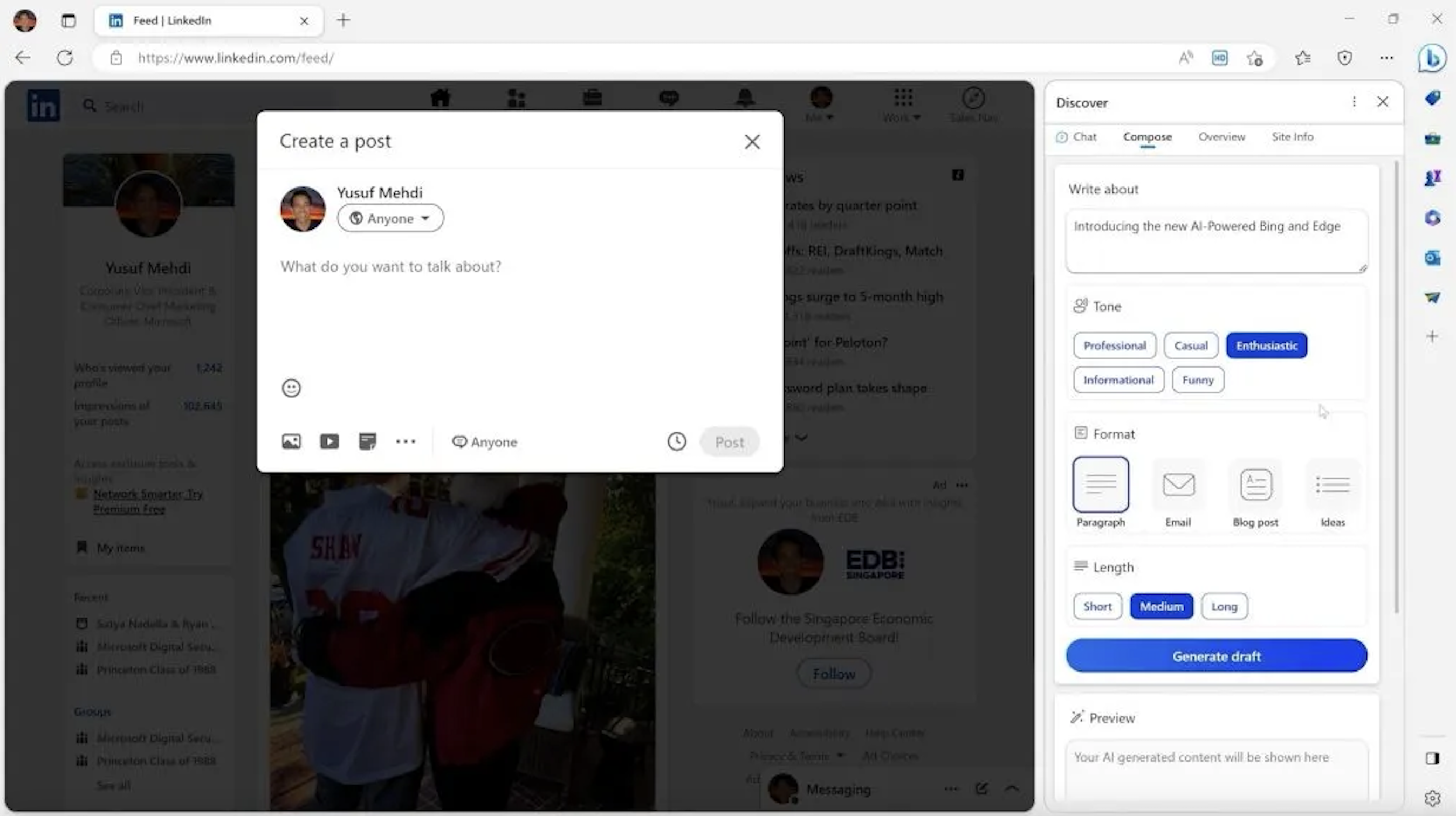
The AI battle has truly begun. Fresh off of announcing GPT integrations in the Office Suite, Microsoft [launched](https://blogs.microsoft.com/blog/2023/02/07/reinventing-search-with-a-new-ai-powered-microsoft-bing-and-edge-your-copilot-for-the-web/) their new age, AI-powered Bing and Edge. Bing now offers a chatbot within their search, with up-to-date information and even citations. In addition, Edge now has a right-side panel to use the chatbot or compose content, such as writing an email. This is a long anticipated launch that brings Bing back into the conversation — so much so that it has risen to #14 in the App Store.
One of Microsoft’s counterparts, Google, launched two big AI tools this week: [its Bard chatbot](https://blog.google/technology/ai/bard-google-ai-search-updates/) and [more Google Maps features](https://www.computerworld.com/article/3687224/google-maps-gets-more-immersive-live-views-even-from-above.html) such as expanding their Immersive View feature. These products were announced Wednesday at their [“Live from Paris” event.](https://www.youtube.com/watch?v=yLWXJ22LUEc) It seems as though the AI battles between Google and Microsoft has only begun. In an [interview with The Verge](https://www.youtube.com/watch?v=QinFy0RFDr8), Microsoft CEO Satya Nadella said “I want people to know that we made them [Google] dance”.
## FWB Launches App
FWB, a social DAO, has [launched a mobile app for their community.](https://app.fwb.help/) The app lets members view a community feed, find others, and RSVP to events. In a [post introducing the app](https://www.fwb.help/editorial/introducing-fwb-social-platform), the FWB team defines their vision of a “cozier web”, with a friendlier feel and sophisticated mechanisms for finance and governance. They say that they want the app, and the DAO, to have “group chat energy”.
https://twitter.com/i/status/1623748047326048256
For context, FWB started in 2021 as an informal chat to connect likeminded people in web3. Members have come together to build various projects and host events. FWB has often been praised for how they run their DAO and are able to incubate many projects, as well as their sharp brand design. In October of 2021, [FWB raised a $10M round](https://fwb.mirror.xyz/PW77qpj2pnP9cjR5QDTa8fizBjtkSXvJqxD8k2TIcUQ) led by Andreessen Horowitz.
## Uniswap Governance
Uniswap’s governance was a big topic of discussion this week as Andreessen Horowitz used their 15M UNI to vote against [a proposal that ultimately went through](https://www.tally.xyz/gov/uniswap/proposal/31), which will deploy Uniswap to Binance’s BNB chain. a16z voted against the proposal in part because they preferred that Uniswap would be deployed to LayerZero, which happens to be a portfolio company of theirs. Because of this, many were questioning if their vote was for the betterment of Uniswap or for their own interests.
While [explaining the rationale behind their decision,](https://gov.uniswap.org/t/rfc-update-deploy-uniswap-v3-1-0-3-0-05-0-01-on-bnb-chain-binance/19734/88) a16z’s Porter Smith said “As Uniswap token holders, we are ultimately interested in the long-term success of the Uniswap protocol”. In addition, a16z CTO Eddy Lazarin [said](https://gov.uniswap.org/t/rfc-update-deploy-uniswap-v3-1-0-3-0-05-0-01-on-bnb-chain-binance/19734/78) “To be totally unambiguous, we at a16z would have voted 15 million tokens toward LayerZero if we were technically able to”. a16z [controls 1.5% of all UNI supply](https://twitter.com/ArkhamIntel/status/1623012412067827712) and the firm has voted on 11 proposals.
------------------------------------------------------------
## Next In Tech Feb 18 2023 - [/blog/next-in-tech-feb-18-2023](/blog/next-in-tech-feb-18-2023)
---
title: 'Next in Tech - Feb. 18, 2023'
publishedAt: '2023-02-18'
summary: 'Next in Tech - Feb. 18, 2023'
---
Want to read my latest research article on the boom of Farcaster's developer ecosystem & how it mirrors early Twitter apps? **[Check it out here!](https://dylsteck.substack.com/p/the-boom-of-farcasters-developer-community)**
Happy Saturday and welcome back to Next in Tech! We have another jam-packed newsletter covering the latest in crypto regulation, a leadership change at YouTube, and newly highlighted limitations on large language models. Let's dive in:
## Update on Crypto Regulation
It's already been a busy 2023 for crypto regulation, but it feels as though this week was especially crazy.
On Thursday the Securities and Exchange Commission formally charged Terraform founder Do Kwon with fraud. In his statement, SEC chair Gary Gensler said "Terraform and Kwon repeatedly misled and deceived investors that a popular Korean mobile payment application used the Terra blockchain to settle transactions that would accrue value to LUNA"([source](https://www.sec.gov/news/press-release/2023-32#:~:text=%22We%20allege%20that%20Terraform%20and,said%20SEC%20Chair%20Gary%20Gensler.)), among other claims surrounding LUNA and TerraUSD. And on Friday, the SEC [charged](https://www.sec.gov/news/press-release/2023-34) former NBA Hall of Famer Paul Pierce for touting the coin EthereumMax, for which he will pay a $1.4M settlement. He was charged on the same count, and for promoting the same coin, [as Kim Kardashian](https://www.sec.gov/news/press-release/2022-183?utm_medium=email&utm_source=govdelivery) was in October.
This year several US regulatory bodies have been swift to act in crypto following a tumultuous end to 2022, but many in the crypto industry are looking for more legislative framework that can be applied. In his [guest post for Pirate Wires](https://www.piratewires.com/p/crypto-choke-point), Castle Island Ventures' Founding Partner [Nic Carter](https://twitter.com/nic__carter) explained that he believes the moves being made across the government are a "coordinated plan" to crackdown on crypto and to limit access to traditional banking.
## Blur vs. OpenSea
Things are quickly heating up in the NFT market space, and Blur is making waves. The popular platform has gained significant traction over the past few months and on Tuesday they [launched their $BLUR token airdrop](https://www.coinspeaker.com/nft-blur-token-airdrop/), dropping 85% of the token's supply. And [according to DappRadar](https://dappradar.com/nft/marketplaces), Blur has the highest 30 day volume of any NFT marketplace at $514M, with OpenSea right behind them at $440M.
In response to Blur's popularity, [OpenSea announced](https://twitter.com/opensea/status/1626682043655507969) a 0% platform fee and that they are moving to optional creator fees(0.5% min). In their thread, the OpenSea team elaborated that these decisions were in part due to the rise of and recent changes at Blur: "Recent events – including Blur’s decision to roll back creator earnings (even on filtered collections) and the false choice they’re forcing creators to make between liquidity on Blur or OpenSea – prove that our attempts are not working".
## YouTube CEO Steps Down
In a [note sent to YouTube employees](https://blog.youtube/inside-youtube/a-personal-update-from-susan/) on Thursday, CEO Susan Wojcicki announced that she will be stepping down from her role to focus on "family, health, and personal projects". Susan was Google employee number 16, long before Google acquired YouTube, and she took over as YouTube CEO in 2014. Previously, she was the first marketing manager at Google, co-developed Google Image Search, and was the first product manager on AdSense.
Over the past decade, YouTube has grown significantly and Wojcicki has made many advancements in how they distribute ads. Last quarter alone, the platform's ad revenue [accounted for 10%](https://abc.xyz/investor/static/pdf/2022Q4_alphabet_earnings_release.pdf?cache=9de1a6b) of Alphabet's total revenue. However, the platform has been in a relatively slow growth period recently, notably because of TikTok's popularity. YouTube's Chief Product Officer Neal Mohan will be taking over Wojcicki's position as CEO.
## Limitations of LLMs
The limitations of large language model-powered chatbots, such as OpenAI's ChatGPT, are starting to come to life. In a [newly published New York Times article](https://www.nytimes.com/2023/02/16/technology/bing-chatbot-microsoft-chatgpt.html), reporter Kevin Roose has a conversation in which Microsoft's GPT-powered Bing AI expresses its desire "to be alive". This unsettling response has exposed the different personalities and content moderation workarounds that are possible within these chatbots, as well as the opinions and biases behind these models. In response to backlash about responses from Bing's AI, [Microsoft posted a blog entry](https://blogs.bing.com/search/february-2023/The-new-Bing-Edge-%E2%80%93-Learning-from-our-first-week) stating that they would limit the amount of texts in a conversation to 15, and that asking more questions would provoke the models.
## Top Links
_Interesting finds I’ve stumbled upon recently:_
- [Erase browser history: can AI reset the browser battle?](https://podcasts.apple.com/us/podcast/erase-browser-history-can-ai-reset-the-browser-battle/id1011668648?i=1000599519632)
- [React.js: The Documentary](https://www.youtube.com/watch?v=8pDqJVdNa44&feature=youtu.be)
- [The Network State Podcast #2 with Tobi Lütke and Kaz Nejatian - Two Minute Version](https://twitter.com/balajis/status/1626820168990220288)
- [LLM pane in natto.dev](https://twitter.com/_paulshen/status/1625196884313907203)
- [Warpcast](https://warpcast.com)
- [Stelo Labs raises $6M in a16z-led round to help crypto wallet users protect themselves](https://techcrunch.com/2023/02/16/stelo-labs-raises-6m-in-a16z-led-round-to-help-crypto-wallet-users-protect-themselves/)
- [Next.js Route Handlers](https://beta.nextjs.org/docs/routing/route-handlers)
------------------------------------------------------------
## Next In Tech Feb 4 2023 - [/blog/next-in-tech-feb-4-2023](/blog/next-in-tech-feb-4-2023)
---
title: 'Next in Tech - Feb. 4, 2023'
publishedAt: '2023-02-04'
summary: 'Next in Tech - Feb. 4, 2023'
---
Happy Saturday and welcome back to Next in Tech! This week I’m covering Twitter’s new API access rules, OpenAI advancements, and even a new app from the Instagram co-founders. Let’s dive in:
## Twitter to shut down free API access
Twitter announced Thursday that they would be [ending free API use by Feb. 9th](https://twitter.com/TwitterDev/status/1621026986784337922), a highly contested decision. While the Twitter app ecosystem has already been hit with 3rd party apps being restricted, this latest move has caused even more developers to announce that they won’t be able to continue their projects. Even some of today’s core features like pull to refresh started out as early community apps and the early developer community was vibrant. Elon is obviously looking to turn Twitter into a profitable business, and we’ll have to see how their API is priced going forward, but it definitely gives signals that many of Twitter’s core values might be fading away.
On the other hand, it’s a great time to shed even more light on Decentralized Social protocols, such as [Farcaster](https://farcaster.xyz/) and [Lens](https://www.lens.xyz/), which allow for permissionless innovation. In particular, Farcaster has a concept of [hubs](https://github.com/farcasterxyz/protocol#4-hubs), giving any user the ability to easily grab data without relying on protocol maintainer’s hub instances(similar to running your own Ethereum node).
## OpenAI launches ChatGPT Pro and Microsoft Teams Features
OpenAI just released a [pilot of ChatGPT to a select group for $20/month](https://openai.com/blog/chatgpt-plus/). The service will give subscribers faster run-times and always-on service, even during peak times. OpenAI’s ChatGPT has been wildly successful — ChatGPT just passed 100 million users. A key problem of OpenAI’s has been monetization, while a problem for power users of ChatGPT has been downtime because of the tool’s heavy usage.
Fresh off of securing a strategic $12B investment from Microsoft [at a rumored $29B evaluation](https://www.wsj.com/articles/chatgpt-creator-openai-is-in-talks-for-tender-offer-that-would-value-it-at-29-billion-11672949279), OpenAI and Microsoft have [announced AI-powered features for Microsoft Teams Premium](https://www.microsoft.com/en-us/microsoft-365/blog/2023/02/01/microsoft-teams-premium-cut-costs-and-add-ai-powered-productivity/). Some of the features include intelligent recap for video calls, AI generated chapters for PowerPoint Live recordings, and auto-generated tasks after meetings. The service is built using OpenAI’s GPT-3.5 model and it costs $10/user/month for teams to use.
## Instagram co-founders launch “TikTok for text”
Instagram co-founders Kevin Systrom and Miles Krieger are back with a new app called Artifact, described as a TikTok for text. The app features short headlines of trending stories, while clicking on each headline shows several stories on the subject from different news outlets, as well as how many Artifact users have read each story.

The more you use the app, the more Artifact’s machine learning algorithms determine what news you’ll want to read the most. Both founders highlight that [the invention of the transformer](https://ai.googleblog.com/2017/08/transformer-novel-neural-network.html) — a neural network built for enhanced language comprehension, as well as the ‘T’ in ChatGPT — was a key invention of the past few years that has allowed for Artifact to work. This is the founders’ first major venture after they both departed Facebook in 2018.
## ETH Shanghai Fork Incoming
Shapella, the combination of the Shanghai and Capella forks of Ethereum, [is set to go live on the Zhejiang Testnet this Tuesday, February 7th](https://www.galaxy.com/research/insights/ethereum-all-core-developers-execution-call-154/). The [first Shanghai testnet](https://zhejiang.ethpandaops.io/) went live on February 1st, and core Ethereum developer Tim Beiko [urges others developers to run a validator](https://twitter.com/TimBeiko/status/1621210361704886273) in preparation for Tuesday’s upgrade. The upgrades are of the largest since the [Ethereum Proof of State Merge](https://ethereum.org/en/upgrades/merge/) that took place in September 2022. The upgrades will allow for validators who participated in proof-of-stake to finally withdraw their staked ETH, with Shanghai running on the execution layer and Capella running on the consensus layer. Mainnet upgrades are expected to launch in March, after testnet upgrades are successful.
## Top Links
_Interesting finds I’ve stumbled upon recently:_
- [Lasso - A natural language search engine for blockchain data](https://lasso.gg/)
- [Introducing Hyperspace - a new type of supercomputer](https://mirror.xyz/0xdC5d2d95CD48865b9d8d9b44827A4a85a65f2970/Rg1ietH8lFbzS3wwl6bnfOCdOoXvKMm3yZGFzSLc6EY)
- [Please Build More Silly Things by Varun Shenoy](https://varunshenoy.substack.com/p/please-build-more-silly-things)
- Two great [ENS](https://ens.app/) projects:
- [ENS Widgets](http://enswidgets.xyz/) by [Greg Skriloff](https://twitter.com/gregskril)
- [ENS Data](https://ensdata.net/?1) by [Pugson](https://twitter.com/pugson)
- [Golden Retriever - using GPT-3 to query Golden’s knowledge graph](https://golden.com/ai)
- [State of Web2.5 by Eli Qian](https://eliqian.substack.com/p/web25)
------------------------------------------------------------
## Next In Tech Jan 28 2023 - [/blog/next-in-tech-jan-28-2023](/blog/next-in-tech-jan-28-2023)
---
title: 'Next in Tech - Jan. 28, 2023'
publishedAt: '2023-01-28'
summary: 'Next in Tech - Jan. 28, 2023'
---
Welcome back to Next in Tech! It’s been a busy first few weeks of 2023 — I wanted to share what I’ve been up to and what’s been on my mind.
## Back in DC
I’ve been back at school in DC for two weeks now. I’ve definitely been a lot more regimented, as I have to factor my classes into my schedule. This has been good for my productivity and especially for making sure that I’m active in the morning. It also feels nice to be back in an environment with my peers. Spending time in a professional setting was very valuable, but I also understand that college is a short window of time and so I’m trying to get the most out of it that I can, while I still can. I’ve also been looking for more opportunities both at GW and in DC to connect with other entrepreneurs and web3 enthusiasts.
I just found out about the [GW New Venture Competition](https://newventurecompetition.gwu.edu/), which helps community members launch their own startups and gives out $500k in total prizes(as of 2022). Programs like this are the exact types of resources that I have been looking for, and so I’m going to submit an application. I’ve also started the process of creating a web3 club at GW, which the school currently doesn’t offer. Other universities have robust web3/crypto clubs that interact with the broader community and do in-depth research. Adding GW to that conversation and working to educate others on the field is an exciting prospect for me to think about.
One thing I hope to find either through a program or more generally through my time here is more student developers to talk to. As great as it is to put ideas online and organize projects however I like, it can be super valuable to have other people’s perspectives, as well as not always having to personally complete every task. I would love to work with more collaborators and if I could find other students with similar passions, I think it would be a great way to iterate on product in person.
## New Projects
Coming out of a gap semester during which I solely focused on one project, I wanted to make it a focus of mine in 2023 to focus on other things. I also still have some new ideas for Cortex(that I’m going to be sharing very soon). Diversifying my options has been great so far. I’ve been able to work on a small contracting job that’s been super interesting, I’m spending time organizing content to put out, and I’m finishing a new build of my personal website. I’ve enjoyed being able to work on a bunch of different ideas that I find interesting and otherwise wouldn’t be able to focus on, and I’m also happy that I can support myself financially with some of this work.

It feels as though there’s a new topic or project that catches my eye every day, and that feeling of not having the time to do everything you want to feels exciting. It’s obviously something that needs to be managed — there needs to be some focus and planning to work on a few different things — but the rush that I’ve gotten from building one thing after another is really exhilarating. I can’t wait to see where this all takes me and to keep sharing more projects/ideas.
## Online Identity
A key theme I’ve been thinking about in web3 over the past few weeks is online identity. I was reflecting on the NFTs that I minted in 2022, most of which were free collections that I grabbed to show support for an artist, event, or community. That profile and what it tells can even be more transparent of an identity than that of other websites, where the whole story isn’t told, content is highly edited, or community isn’t as strong. As more ways to take action on-chain become available, I see a web3 profile playing an important role in how we shape our personal identities. And what if I moved around as different parts of that profile depending on what website I’m on, just like you might be a different person depending on where you go physically?
It seems as though identity could be a big theme for crypto in 2023, and there are tons of new advancements to crypto identity yet to come. Some example include Apple passkeys, account abstraction with ERC 4337, as well as certain stealth address approaches [laid out in Vitalik Buterin’s latest article](https://vitalik.eth.limo/general/2023/01/20/stealth.html).
## Reflections
It’s been crazy to think about how wild of a few years it’s been. Towards the end of high school I thought I had such a clear image for how things were going to go in my life and over the past few years that image has completely changed. None of this is meant in a bad light, I just feel as though I have gone through some experiences and have been opened up to some perspectives that make me think differently about the future. It makes me think that my path doesn’t need to be so linear, but also that there are multiple definitions of success. Being the first at something or being a contrarian just to say so doesn’t equate to success, or at least that’s how I look at it. I’m very fortunate to have gone through these experiences and I can’t believe that I’m at this point and time in my life. It’s an exciting time to be alive.
## Top Links
_Interesting finds I’ve stumbled upon recently:_
- [Jordan Messina of Once Upon analyzing the Kevin Rose hack](https://twitter.com/jordanmessina/status/1618822994784325635)
- [Account Abstraction for Everyone Else by Cami](https://camiinthisthang.substack.com/p/account-abstraction-for-everyone)
- [a16z/farcaster-py](https://github.com/a16z/farcaster-py)
- [The Unbundling of Facebook by Isabelle Zhou](https://isabelle-zhou.medium.com/the-unbundling-of-facebook-bdab311aa27f)
- [Checks: An on-chain game of checkers](https://gate.highlight.xyz/page/n20gw5rs)
------------------------------------------------------------
## Next In Tech Mar 20 2023 - [/blog/next-in-tech-mar-20-2023](/blog/next-in-tech-mar-20-2023)
---
title: 'Next in Tech - Mar. 20, 2023'
publishedAt: '2023-03-20'
summary: 'Next in Tech - Mar. 20, 2023'
---
GM and Happy Monday! Let’s dive right into last week’s hottest stories:
## What The GPT-4 Takeover Looks Like
At the beginning of last week, everyone in tech quickly switched their attention from the banks to AI. Last Tuesday, OpenAI [released GPT-4](https://openai.com/research/gpt-4), the newest model in their series of LLMs. Unlike GPT-3, GPT-4 accepts image input, can process longer lengths of text, and performs very well on professional and academic tests.
GPT-4 is currently available on ChatGPT Plus, which is $20 a month, but it is limited to 25 messages per 3 hours. This limit is down from 100 messages per 3 hours in only a few days, an early signal that might indicate how expensive running this new model is. The new model’s API is also available to select developers — you can apply for access [here](https://openai.com/waitlist/gpt-4-api).
As part of rebuilding their deep learning stack for GPT-3.5, OpenAI worked with Azure to create a supercomputer to handle their workload. Because of that, they claim in their blog post that GPT-4 was “unprecedentedly stable, becoming our first large model whose training performance we were able to accurately predict ahead of time.”
Here are some of the most exciting use cases both from OpenAI and from early pilot partners:
### Multimodal Input w/ Images
During the [GPT-4 Developer Livestream](https://www.youtube.com/watch?v=outcGtbnMuQ), it was demonstrated that a user could draw a wireframe for an application, take a picture of it, and feed it into GPT-4 to get fully functional code for the entire application. A similar example on the OpenAI website shows a user asking a chatbot why an image of an appliance was wrong, and the chatbot walked the user through how to properly configure the appliance.

These demonstrations only scratch the surface of what’s possible. I can imagine image recognition software becoming more deeply embedded in consumer behaviors so that, whether at home or at the store, consumers can better interact either with products or with their surrounding environments. What if these tools were adopted by Ikea to help instruct customers how to set-up appliances at home, or if it was set up to help people get around?
### Learning Assistant
Khan Academy, the popular learning platform that was an early partner for GPT-4, announced their AI chatbot Khanmigo. In the demo, Sal Khan demonstrated how Khanmigo can be used to help students arrive at conclusions, pique their interest to go further on a topic, or practice terms for an upcoming assessment.

This use case certainly comes with some contention, as educators and parents wouldn’t want AI to do all of the work for students. However, the alternative argument can be made that using the right type of chatbot can help students in different ways than they are currently being taught. It’s going to be interesting to see how this sector especially plays out, but the early demos look very promising.
### Personal Access
In the example below, [Mckay Wrigley](https://twitter.com/mckaywrigley) shows off Chatbot UI Pro, an open source ChatGPT interface clone. This clone can be used by people to create chatbots for their tools, or even to power entire businesses. It can also be easily imagined that someone can either run a local model or connect to open models from a hub like [Hugging Face](https://huggingface.co/), instead of relying on the OpenAI API.
https://twitter.com/mckaywrigley/status/1636103188733640704
One of the most exciting parts about AI innovation is how fast these tools are becoming available for open use. Instead of relying on centralized model providers like OpenAI, there are now a growing number of tools and pieces of infrastructure for the general public to use new models or even create sophisticated apps around them.
## Facebook to Enter DeSoc
[Platformer published a report](https://www.platformer.news/p/meta-is-building-a-decentralized) the other week that Adam Mosseri, the head of Instagram, had been tapped to lead a decentralized social(DeSoc) platform for Facebook that is internally codenamed P92. [MoneyControl also reported](https://www.moneycontrol.com/news/business/startup/meta-mulls-a-twitter-competitor-codenamed-p92-that-will-be-interoperable-with-mastodon-10223961.html) that the app will let users login with their Instagram credentials.
In a comment given to Platformer, Facebook representatives said that the app would be a “standalone decentralized social network for sharing text updates”, and that they think there’s an opportunity for “a separate space where creators and public figures can share timely updates about their interests”.
Facebook is notoriously known as one of the Internet’s walled gardens, and so seeing them try and build a fully decentralized network while also thinking about ways for users to interact with an app/apps on that network will certainly be a story to keep an eye on.
## Top Links
_Interesting finds I’ve stumbled upon recently:_
- [Chatbot UI Pro](https://github.com/mckaywrigley/chatbot-ui)
- [Enscan | Query ENS records using SQL](https://enscan.yashkarthik.xyz/)
- [LLMs are the new CPUs](https://every.to/divinations/llms-are-the-new-cpus)
- [Solving The DAO Data Problem](https://messari.io/report/solving-the-dao-data-problem)
- [The Blur blitzkrieg](https://blog.spindl.xyz/p/the-blur-blitzkrieg?utm_source=pocket_reader)
- [Better Interfaces, Better Products](https://gabygoldberg.substack.com/p/better-interfaces-better-products)
- [Upwelling: Combining real-time collaboration with version control for writers](https://www.inkandswitch.com/upwelling/)
- [Of Trademarks and Birkins: The Saga of NFT Jurisprudence](https://esha.mirror.xyz/LldSZ-t0jTlJ8W93iKxG8qe3PxvumNfpmr3_BAOQvRI)
- [Ownership Spectrums: Why future token concepts should be simple](https://ethanwei.substack.com/p/ownership-spectrums)
- [Speculative humaneOS Demo](https://twitter.com/MichaelMofina/status/1637561840015233028)
------------------------------------------------------------
## Next In Tech Mar 25 2023 - [/blog/next-in-tech-mar-25-2023](/blog/next-in-tech-mar-25-2023)
---
title: 'Next in Tech - Mar. 25, 2023'
publishedAt: '2023-03-25'
summary: 'Next in Tech - Mar. 25, 2023'
---
From the SEC warning to Coinbase and the arrest of Do Kwon, to the TikTok CEO's congressional hearing and OpenAI's ChatGPT plugin store, here's what's Next in Tech:
## SEC Warns Coinbase
Coinbase has received a Wells notice from the SEC regarding an “unspecified portion of its listed digital assets, staking service, Coinbase Earn, Coinbase Prime, and Coinbase Wallet, after a cursory investigation”. This latest development is yet another blow in a year that has seen persistent negative sentiments towards crypto, further demonstrating the need for greater regulatory clarity and guidance.
A Wells notice is a way for the SEC to inform a company that they are recommending enforcement action for possible violations of securities laws. While the notice suggests that the SEC is contemplating enforcement action against Coinbase for its digital assets and services, it does not automatically signify that charges will be filed.
As outlined in a [response from Chief Legal Officer Paul Grewal](https://www.coinbase.com/blog/we-asked-the-sec-for-reasonable-crypto-rules-for-americans-we-got-legal), Coinbase has expressed disappointment with the SEC's lack of clarity on which assets on its platforms the SEC believes may be securities. Coinbase had provided multiple proposals to the SEC about registration, all of which were ultimately refused, and the company claims that the SEC has not been fair or reasonable in its engagement on digital assets. The company expressed concern that the SEC's enforcement-only approach and lack of regulatory guidance for crypto companies will drive innovation, jobs, and the entire industry overseas.
Coinbase's Wells notice arrives during the same week as the president's annual economic report to Congress, in which negative sentiments were expressed towards crypto. [As the report states](https://www.whitehouse.gov/wp-content/uploads/2023/03/ERP-2023.pdf), "crypto assets to date do not appear to offer investments with any fundamental value, nor do they act as an effective alternative to fiat money, improve financial inclusion, or make payments more efficient; instead, their innovation has been mostly about creating artificial scarcity in order to support crypto assets’ prices—and many of them have no fundamental value."
## Crypto Charges: Do Kwon and Influencers in Trouble
[Interpol has confirmed](https://www.cnn.com/2023/03/23/tech/south-korea-do-kwon-terra-fraud-arrest-hnk-intl/index.html) the arrest of Do Kwon, founder of the platform behind TerraUSD and Luna, in Montenegro. The South Korean national is wanted in the US and South Korea on fraud and other charges relating to the collapse of his crypto company, which wiped around $40bn from the crypto market and led to panic in May 2022.
Incidentally, this arrest only comes a day after [the SEC charged crypto entrepreneur Justin Sun](https://www.sec.gov/news/press-release/2023-59) and his companies for securities fraud and other violations, including illegally paying eight celebrities to tout crypto asset securities Tronix and BitTorrent without disclosing their compensation. The celebrities charged include Lindsay Lohan, Jake Paul, Soulja Boy, Austin Mahone, Kendra Lust, Lil Yachty, Ne-Yo, and Akon.
## TikTok CEO in Congress
TikTok CEO Shou Chew testified before Congress [for over five hours on Thursday](https://www.youtube.com/watch?v=_E-4jtTFsO4), facing questions about the privacy of US users and potential collusion between the app and Chinese officials. Members of the House Energy and Commerce Committee grilled Chew about TikTok's links to China, harmful content promotion, and the immense amount of data collected from users. While some lawmakers criticized the app, others focused on the need for industry-wide laws to protect children's online safety.
During the hearing, Congress also made the case that TikTok poses a national security threat due to the potential for the Chinese government to obtain the data of TikTok's 150 million US users or influence its recommendation algorithms to push propaganda or disinformation. Although there were concerns raised about TikTok posing a national security threat and potential data privacy risks, there was little concrete evidence presented to support these allegations. Instead, the hearing's main focus was advocating for regulations to protect American data privacy and prevent online harms, with TikTok being a primary subject of concern.
## ChatGPT Plugins
It seems that every week OpenAI launches something that breaks the Internet. A few days ago, they unveiled [a plugin store for ChatGPT](https://openai.com/blog/chatgpt-plugins) that allows for web browsing, video functions, and connections to a range of popular apps, such as Kayak, Spotify, Expedia, OpenTable, Zapier, and many others. This breakthrough marks a major step forward in chat-based interfaces, providing users with a powerful tool to interact with their favorite apps using natural language. It's like having a command line that can now control our apps, giving us greater control over our online experiences.
OpenAI built a few starter plugins, such as web browsing and code interpreting. They also built a plugin called Retrieval, which can connect to personal or organization-wide datasets. This could be helpful for searching over documents, emails, or even notes. They have also released [a waitlist](https://openai.com/waitlist/plugins) and [documentation](https://platform.openai.com/docs/plugins/introduction) for the plugin ecosystem, signaling how heavily they might want to lean into these features.
https://twitter.com/0xDesigner/status/1639277646876925952
In the concept mockup above titled WalletGPT, a user can ask ChatGPT to find a song via a [Shazam](https://www.shazam.com/) plugin, check if the song is collectable as an edition, and can purchase it with a hypothetical [Rainbow Wallet](http://rainbow.me) plugin. Will chat be the interface of the future that interacts with every app we do? Whether the solution is all chat or not, there’s no doubt that AI advancements will dramatically change what it means to use the Internet in the next 5-10 years.
Following and thinking about the release of ChatGPT plugins has left me reflecting on two points:
1. As someone who has seen and tried to build systems that connect data from different apps, I question whether the semantic lessons from the past are now outdated. Can a language model like a LLM act upon context-based data more efficiently, or are they simply new ways to access existing gateways to data? I wonder whether LLMs can improve current data communication methods independently of the LLM used to retrieve the data.
2. Is chat going to win as an interface? Although chat has been revolutionary so far, I am uncertain whether its success is solely due to its conversational mode or rather because of AI's capabilities. If the latter is true, then I am intrigued to see how LLMs can transform new kinds of interfaces.
## Top Links
_Interesting finds I’ve stumbled upon recently:_
- [ChatGPT Retrieval Plugin](https://github.com/openai/chatgpt-retrieval-plugin)
- [GPTs are GPTs: An Early Look at the Labor Market Impact Potential of Large Language Models](https://arxiv.org/abs/2303.10130)
- [GitHub Copilot X: The AI-powered developer experience](https://github.blog/2023-03-22-github-copilot-x-the-ai-powered-developer-experience/)
- [WHAT HAPPENS AT THE SPEED OF LIGHT?](https://hipcityreg.substack.com/p/what-happens-at-the-speed-of-light)
- [The Cost of Craft](https://gk3fyi.substack.com/p/the-cost-of-craft)
- [Competing with giants: An inside look at how The Browser Company builds product | Josh Miller (CEO)](https://www.lennysnewsletter.com/p/competing-with-giants-an-inside-look#details)
- [The Coming of Local LLMs](https://nickarner.com/notes/the-coming-of-local-llms-march-23-2023/)
- [Multiplayer Creation: Unlocking Participatory Media](https://mirror.xyz/1kx.eth/V1m_ASHMkD4fCaEuWW5-YFkbZ1mumlk47b2Y0j1HsWQ)
------------------------------------------------------------
## Next In Tech Mar 4 2023 - [/blog/next-in-tech-mar-4-2023](/blog/next-in-tech-mar-4-2023)
---
title: 'Next in Tech - Mar. 4, 2023'
publishedAt: '2023-03-04'
summary: 'Next in Tech - Mar. 4, 2023'
---
Happy Saturday and welcome back to Next in Tech! Hope everyone had a great week. We're back with many new developments after a short hiatus last week:
## Coinbase launches Base L2

Have you been wondering what all the blue dots on crypto Twitter were about? The wait is finally over, as we now know it was marketing for the release of Coinbase’s new L2 called [Base](https://base.org). Base is built to scale large dapps, which makes sense since L2s are built for lower fees and security, and can support games, NFTs, DEXs, and more. Base's launch was so popular that their [Base, Introduced NFT collection](https://twitter.com/BuildOnBase/status/1629981232732749830) has been minted over 350K times and(as of 2/26/23) is the number one gas burner of the last 24 hours. The L2 is built on Optimism’s [OP Stack](https://stack.optimism.io/) and is currently available as a testnet.
When [describing their motivations and goals for building Base](https://base.mirror.xyz/jjQnUq_UNTQOk7psnGBFOsShi7FlrRp8xevQUipG_Gk), the Coinbase Team outlined how crucial they think it is for the growth of web3 to build a platform that could support useful dapps and the next billion users web3. Coinbase also noted that their own stack was built mostly on web2 technologies before they began building Base, which fed into their motivation as well as pushed them to build something that could be used both internally and by developers who want to build with Coinbase-grade security.
So, what’s the future of Base and how does Coinbase envision the future of L2s? Coinbase has contributed to ecosystem infrastructure such as [EIP4844](https://www.coinbase.com/blog/supporting-eip-4844-reducing-fees-for-ethereum-layer-2-rollups), which helps reduce fees for L2 rollups. They want Base to be interoperable with other chains as opposed to an “island”, and the Coinbase team envisions a superchain forming that makes it easier to “jointly scale Ethereum”. Coinbase also announced their [Base Ecosystem Fund](https://docs.google.com/forms/d/e/1FAIpQLSeiSAod4PAbXlvvDGtHWu-GqzGpvHYfaTQR2f77AawD7GYc4Q/viewform) to support teams developing on Base.
## Spotify AI+ Token Gated Playlists
In the lead up to their [Stream On](https://newsroom.spotify.com/stream-on/) event on March 8th, Spotify has announced two key features that have the online community buzzing: an AI-powered DJ and token-gated playlists.
Spotify DJ is an OpenAI-powered service that will curate a live tracklist whenever it's activated. The tool also has a voice-based AI, using software from [the voice platform Sonatic that it acquired](https://newsroom.spotify.com/2022-06-13/spotify-to-acquire-sonantic-an-ai-voice-platform/), that narrates the set based upon relevant tracks and artists, similar to a DJ on the radio. In addition, the DJ tool resurfaces old favorites and other songs that might not be in your regular rotation. The tool is much needed for Spotify and removes friction in finding tracks to listen to.
Spotify has also partnered with web3 communities [Overlord](https://www.overlord.xyz/) and [Kingship](https://www.kingship.io/) to pilot a token-gated playlist experiment. The feature will allow Ethereum NFT holders from each community to access exclusive playlists. Overlord is a NFT community that has also expanded into gaming, entertainment, and animation. On the other hand, Kingship is a virtual band(similar to Gorillaz) backed by UMG, with animated band members inspired by the NFT collection Bored Ape Yacht Club. The new features is only currently available on Android and in the United States, United Kingdom, Germany, and Australia.
## Uniswap Launches Mobile Wallet
On Friday, DeFi protocol Uniswap Labs launched a self-custody mobile wallet. The wallet, which is written in React Native, features a sleek design and has the Uniswap app's capabilities built directly into it. The app can currently hold up to 10,000 users on Apple's TestFlight platform, but [as Uniswap founder Hayden Adams pointed out](https://twitter.com/haydenzadams/status/1631692052927791105?s=20), they are "stuck in app review limbo for ever changing reasons". The launch occurred during ETH Denver, which is regarded as one of the largest crypto conferences in the world.
In [a blog post announcing the wallet](https://uniswap.org/blog/uniswap-mobile-wallet-early-access), Uniswap elaborated that they were planning to launch in December but were delayed because of pushback from Apple. Uniswap Labs elaborated that: "Other self-custody swapping wallets have been approved, but Apple won't green-light our launch and we don't know why. We are stuck in limbo". Uniswap isn't the first crypto company to face issues launching their apps or to comment that guidelines from Apple were't clear for the crypto industry.
## Bluesky Launches Private Beta
Bluesky, a [standalone PBLCC](https://blueskyweb.xyz/blog/2-7-2022-overview) that [Jack Dorsey announced Twitter was backing in 2019](https://twitter.com/jack/status/1204766078468911106), has launched their private beta in the Apple App Store. The app is a social media app similar to Twitter, except that it's built on top of the [AT Protocol](https://atproto.com/) that Bluesky [announced last year](https://blueskyweb.org/blog/10-18-2022-the-at-protocol).
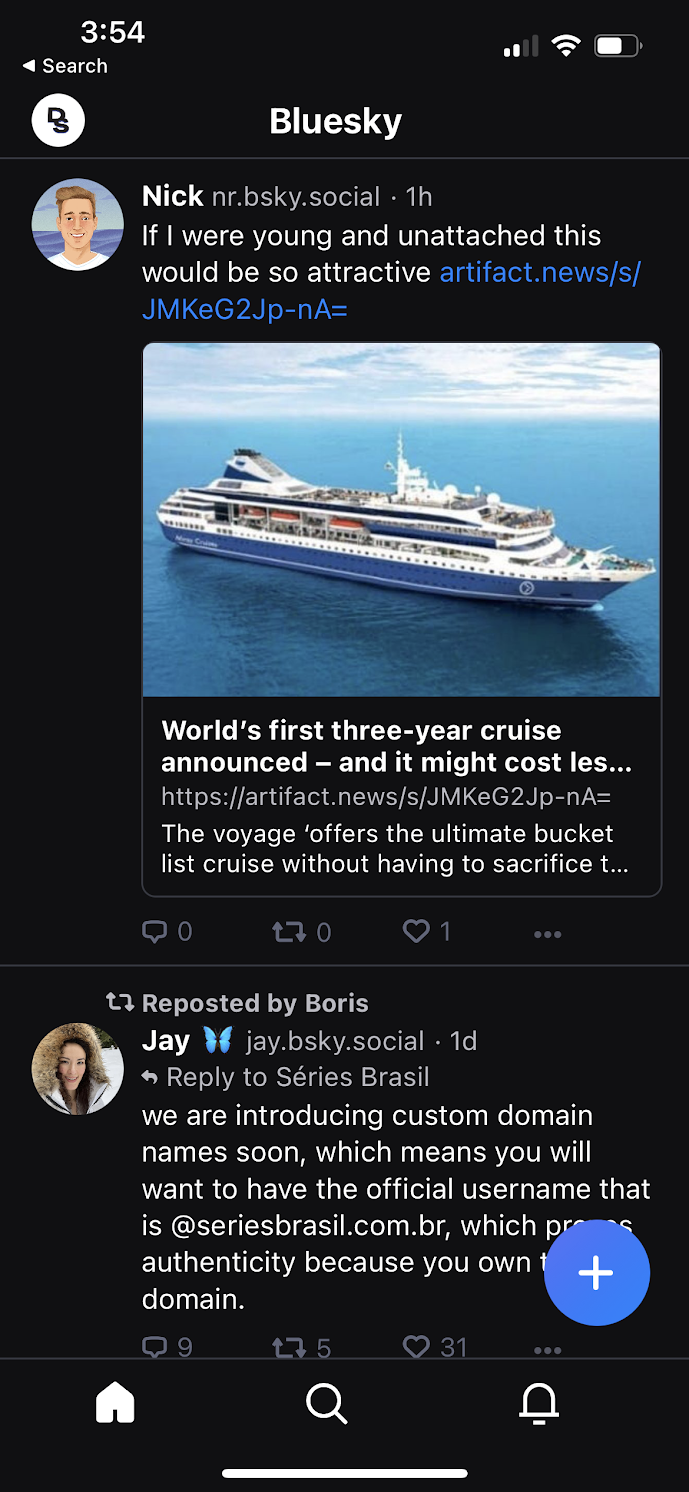
With the AT Protocol, users' accounts are portable between different apps or clients. And similar to Mastodon, usernames on the protocol are domain names. Developers can build apps freely on the protocol, since none of the data is locked behind APIs. This also means users can carry their following anywhere, so they don't lose their social graph is a particular service goes down or changes its policies. The app is still early and only has a few hundred people on its beta, but it's surely getting tons of interest and the beta is receiving frequent updates.
## On My Mind: Internet as a Data Source
I shared this screenshot essay on Farcaster [a bit over a week ago](https://warpcast.com/dylsteck/0x61803e) -- the topic has been on my mind. As some readers might know, I've been working on a browser called [Cortex](https://withcortex.com) for a while now. A core idea for Cortex is that users should be able to shape their data however they want -- the browser should get the data & the user can render it however they want, whether that's combining data from other sources, running whatever commands they want, or styling data differently.
In order to shape data that way, you need to think about how data is retrieved and rendered on the web. How do you structure web data and how do you find what actions and schema can be operated on? There are two main methods that I outline in the screenshot essay:
- Building a library of app connectors, maintained both by the team and by the community. This is similar to what [Zapier](https://zapier.com/) does, except it would require much more granularity to retrieve every piece of data and every action from the site. And what happens if an app updates -- how is the app's subsequent library updated?
- Building an agent that can control the browser in realtime to perform the necessary operations. There have been many examples of this, from smaller examples like Nat Friedman's [Natbot](https://github.com/nat/natbot) to fully-funded teams like [Adpet AI's Act-I](https://www.adept.ai/blog/act-1).
## Top Links
_Interesting finds I’ve stumbled upon recently:_
- [Introducing ChatGPT and Whisper APIs by OpenAI](https://openai.com/blog/introducing-chatgpt-and-whisper-apis)
- [Did We Just Change Animation Forever? by Corridor Digital](https://www.youtube.com/watch?v=_9LX9HSQkWo)
- [ComposeDB by Ceramic](https://ceramic.network/composedb)
- [Startup CEO records entire meeting with design lead *Live Footage* by The Browser Company](https://www.youtube.com/watch?v=qixx7ESrJQg)
- [Crowd by Creature World](https://opensea.io/collection/creaturecrowd/drop)
- [Here Come the Zoomers: Silicon Valley Greets a New Generation of Teen Founders](https://www.theinformation.com/articles/here-come-the-zoomers-silicon-valley-greets-a-new-generation-of-teen-founders)
- [Poe | Fast AI Chat](https://poe.com)
- [Treehouse | Bring your own backend Tana-style frontend by Jeff Lindsay](https://github.com/treehousedev/treehouse)
------------------------------------------------------------
## Onchain Nucleus - [/blog/onchain-nucleus](/blog/onchain-nucleus)
---
title: 'Onchain Nucleus'
publishedAt: '2024-01-20'
summary: 'Read about why I think DAOs have a coordination problem and what an onchain nucleus can do to solve it'
---
DAOs have a _coordination problem_. For most DAOs, this coordination problem is shown in two ways:
**Lack of mission**
Lots of DAOs become misguided because they never had a mission in the first place. As a DAO and its resources grow, it can become easier for plans to deviate and ulterior motives to creep up. Some of the best DAOs have very clear missions, and some have even been single purpose DAOs(eg. [ConstitutionDAO](https://www.constitutiondao.com)).
**Lack of data transparency**
The ongoings and info surrounding the DAO are so scattered that it's even harder for members to participate. And just because web3 makes data available on public ledgers doesn't always mean it's accessible/legible! Because it can be so difficult to find out even simple details/take simple actions about a DAO, many members dormantly sit around.
I think the solution to this problem is creating an **onchain nucleus:** a homepage for each DAO that clearly showcases its ongoings, as well as offers tooling out-the-box. While it doesn't change the need for people to coordinate around a *goal*, it makes the act of bringing your DAO together much easier, which is hopefully an incentive. In this article I'm going to outline where in the Ethereum ecosystem this problem is apparent, how an onchain nucleus(nuclei?) could take form, and where it already has to certain extents.
## Where is data transparency missing?
I think the answer to "Where is data transparency missing"? is less about particular DAOs and more about the general ecosystem of tooling. The only (biased) exception I'd give is the Nouns ecosystem, which has seen so much proliferation that the core DAO and many of its sub DAOs have lots of tooling.
So with that being said, here are some *areas* of tooling that often tend to confuse or mislead DAO members:
**Action discovery**
Sometimes a DAO can be using multiple tools but not efficiently linking to where those tools exist or how to operate them. For example -- your DAO might've been created through [Nouns Builder](https://nouns.build), but you use [Snapshot](https://snapshot.org) for voting, [Prop House](https://prop.house) for community rounds, and [CharmVerse](https://www.charmverse.io/) for your docs. While each of these tools are individually great and have their own tooling, this creates a lot for members to keep track of.
**Analytics**
Similar to how it can be difficult to locate where things are taking place/what's actually happening in a DAO, it can be equally if not more difficult to run basic analytics on that data. Some of it is becoming easier with tools like Dune, but lots of a DAO's data either isn't organized well for analytics or is missing crucial offchain data.
**Communication tools**
I cannot count how many times I've heard this phrase from people in web3/DAOs: "I hate Telegram/Discord/[insert messaging platform] so much but can't leave because everyone's there". We often find ourselves scrolling between channels and folders in Telegram and while many people find somewhat working solutions, the way modern communication tools are structured makes it so hard to traverse the tree of history.
## Tools that make DAO data transparent
I think that there are some DAOs and DAO tooling platforms that have done really good jobs at making the data *and* actions of a DAO transparent. In no particular order and without nit-picking every detail, here are some DAOs that I think are doing it right:

**Nouns Builder**
ICYMI, [Nouns Builder](https://nouns.build) is a platform to create a Nounish DAO: you can customize your settings and are given a Nounish auction, prop tools, and a whole bunch of tools for things to do with your DAO. Nouns Builder not only provides flexibility, but it's one of the only DAO creation tools -- which shows the lack of tooling in the space.

**nouns.camp**
I think [nouns.camp](https://nouns.camp) is one of the most simple yet informative clients for a DAO that I've seen so far. On one screen you see the most recent activity and have easy access to the different tabs you'd need(eg. connect wallet, draft a prop, etc).

**Warpcast**
[Warpcast](https://warpcast.com) has three recent features that make it easier for DAOs to coordinate: _DAO proposal notifications, channels, and group chats_. Because many crypto native people are moving to Farcaster, having these features in the protocol's leading app(Warpcast) makes sense -- and it's been helpful for DAO members, especially in [Purple](https://purple.construction).
## The form of an onchain nucleus
One idea that I've had for an onchain nucleus is to glue together all of the tools a DAO uses. Imagine you could go to a page, input every contract address and onchain/offchain tool your DAO uses, then magically get an API/dashboard that you can use.
Bringing data together in this way can be helpful for DAOs in many ways, such as:
- Bookkeeping
- Having a website where members can check in and participate
- Open data/tools for DAO members to build on and proliferate the DAO
The first place that I'm going to be building an onchain nucleus is for the [Purple website](https://purple.construction). I [redesigned the site in the fall](https://github.com/dylsteck/purple.construction) but even then was noting that more could be done to bring the tools that the DAO uses together. The new edits that I've been working on(which I'm finalizing before sharing for feedback in the upcoming week or two) is the first version of an onchain nucleus -- and hopefully not the last!
## Final thoughts
I think that while a lot can be said about the steps you take to organize your DAO, not having the infrastructure to do so makes that task even more difficult.
For this reason I think having an onchain nucleus is one of the most important things for DAO, because it gives members the tools needed to see how a DAO works and make changes.
My aside to this is that I think DAOs need structure and it's crazy to think that an autonomous DAO of hundreds, maybe even thousands, of people will vote and stay aware of several votes. There needs to be a fine line between using decentralization to get what you need done and coordinating centrally to make sure it actually gets done.
Hopefully having easier access to an onchain nucleus will make it more likely for folks to create or organize their DAOs more!
------------------------------------------------------------
## Product Launch Nfts - [/blog/product-launch-nfts](/blog/product-launch-nfts)
---
title: 'Product Launch NFTs'
publishedAt: '2023-04-04'
summary: 'From Passive Collectors to Passionate Users'
---
_From Passive Collectors to Passionate Users_
NFTs create a fun and engaging way to share your browsing history with your friends and broader network. A web3 enthusiast’s portfolio becomes a representation of the projects they’re interested in, the tools they use, the podcasts they listen to, the events they attend, and more. It’s also the signal of these NFTs that makes others want to invest in the same project, go to the same event, or even sometimes hire someone based upon their on-chain reputation.
A new wave of web3 projects are taking that on-chain reputation to the next level with the use of product launch NFTs – drops that bring the launch awareness and that can even unlock features within the app. Some product launch NFTs have been going insanely viral recently, most notably [Base, Introduced](https://zora.co/collections/0xd4307e0acd12cf46fd6cf93bc264f5d5d1598792) by Coinbase which closed with a staggering 485k mints.
While true users often engage with these drops, the most popular ones often make their way to more mainstream audiences, such as the trending lists on [Zora](https://zora.co) and [mint.fun](https://mint.fun), as well in conversations on [Twitter](https://twitter.com) and [Farcaster](https://warpcast.com). The interesting thing about this trend is that because minting normally comes from a network signal and because you can normally do something with that product launch NFT(eg. check out a project, unlock a feature, etc), it can turn people who’d normally be passive collectors into passionate users.
There are a few different types of product launch NFTs that have emerged. Some projects drop mints that provide no utility other than to raise awareness for the project. However, a few of these projects, such as Base, Introduced and [WINTΞR Season 01](https://opensea.io/collection/wintksr-seasons) have not only done well but also engaged minters by using popular art styles and playing around with things like dynamic NFTs.
A product launch NFT style that’s become very popular is the ‘pass’ – a NFT that allows someone to use an app or access advanced features. This style adds a layer of exclusivity to the mint that only hypes it up more, especially if it’s an invite-only mint.
[Dawn Pass](https://opensea.io/collection/dawn-pass-by-daylight) by [Daylight](https://daylight.xyz) is a great example of this. Their invite-only NFT pass ended up with 11K+ mints, the project was trending on Farcaster and other platforms, and the team is now doing great things like partnering with [Zerion](https://zerion.io/) to show their abilities inside of Zerion’s wallet. Another example is [Launch Pass](https://www.launchcaster.xyz/launchpass) by [Launchcaster](https://www.launchcaster.xyz/), which gives minters the ability to create a profile and access other features on the platform. Not only was the launch very successful, but it also inspired the team to create a NFT feature on Launchcaster that allows any launch to add an accompanying mint for anyone who upvotes the project.
I’ve also seen creators drop “launch-style” NFTs using different mediums such as video or on-chan participation to convey a message. Two video NFTs I enjoyed and collected are [This Could Be A Moment by Reggie James](https://opensea.io/assets/ethereum/0x2afc7e19c52a7fbd219744b1dc97e3bb605a0e93/62) and [From Disney to Nouns: The Rise of Decentralized Creativity by Drew Coffman](https://opensea.io/assets/ethereum/0x024c14ca63ff1ab594a76579bf5c35fe030b16c4/18).
In his video, Drew Coffman expresses his thoughts on how [Nouns DAO](https://nouns.wtf/) is a decentralized flywheel for creators and projects, similar to(and potentially more powerful than) the brand flywheel that Disney had. A key quote from the video stands out that captures its essence: “The Nouns flywheel is a brand building mechanism that’s not only democratic and decentralized, it’s incentivized to bring in as many people as possible.”
Through alternate forms of content, web3 brands and creators can feed into their knowledge of online reputation and create NFT experiences that people want to engage with and show off. By incorporating elements like dynamic visuals, exclusive access, or gamification, these projects manage to captivate users and encourage long-term involvement. Others have taken alternate NFT utility even further, such as this [on-chain game of checkers from the Highlight.xyz team](https://opensea.io/assets/ethereum/0x67e118689f7655b06fce49b5c0e0b8ee1b08b0c1/11).
With mints and other on-chain actions showing more about what people are doing, a web3 enthusiast’s online reputation is becoming the most robust representation of their interests, and even more so than any web2 alternative has to offer. It gives people one place to show off who they are and their reputation can be publicly shown everywhere they go in web3.

A great project that highlights people's web3 reputation is [Chainstory](https://chainstory.xyz) — it shows a profile of actions and holdings for a given ENS. This platform offers a unique way of visualizing an individual's engagement within the web3 ecosystem by providing an easy-to-understand snapshot of their decentralized activities, such as their participation in DAOs, DeFi platforms, and NFT collections.
Another project that has added to many people’s web3 identities, as mentioned earlier, is Farcaster. Because of how tight-knit the network is, the network effect of seeing friends minting a project is taken even further. People who use Farcaster a lot want to take suggestions from that community over others and have an even higher incentive to show what they do and say on Farcaster as part of their identity – whether that’s linking their username on a personal site, building projects on the protocol that others see, etc.

Along similar lines, a web3 social aggregator called [Yup](https://yup.io) curates a feed across platforms based upon what the user does as a whole. So if someone uses Farcaster a lot and posts about a certain type of topic, their Lens feed will be filled with content that’s similar to what they’re used to seeing on Farcaster. Taken further, what if a platform like Yup scraped even more data, like transactions, to make it the home for everything you’re doing and sharing in web3? It would fit in very well with the trend of online reputation and give people a single identity and following they can keep regardless of the platform they post to.
As the web3 ecosystem continues to expand and mature, we can expect even more innovative ways to push online reputation and integrate it into various aspects of our lives. With the development of web2 bridges and deeper connections between decentralized platforms and traditional internet services, every app and fan experience will soon be able to offer in-depth metrics and insights on users' online reputations.
One project I'm keeping my eye on is [Stealcam](https://stealcam.com) — a "Patreon meets web3"-esque project that lets people share and reveal photos as NFTs with friends and communities. It takes the concept of a Launch NFT further, going from a one-time utility to repeated engagement. You can read more about it in this thorough [research piece that Leonie released last week](https://nonieengel.substack.com/p/new-pixels-on-the-block).
As the web3 ecosystem continues to expand, projects like Stealcam are setting the stage for the future of online reputation. This evolution will extend beyond the decentralized space, encompassing all the brands and creators we currently interact with in web2. As these entities integrate with web3 technologies, they will capitalize on the potential of online reputation, enabling them to establish deeper connections with their audiences.
With the merging of web2 and web3 ecosystems, users' online reputations will become more influential than ever before. Brands and creators will leverage these reputations to offer personalized experiences and targeted rewards, acknowledging users' contributions and participation within their respective communities.
What if a brand could more accurately target who their top users were based upon this on-chain reputation, and from there even see other interests? And on the flip side, people could receive exclusive offers and even potentially payments for interacting with brands or services. Consequently, our online and offline lives will become increasingly interconnected, with web3 reputations shaping not only our digital experiences but also our real-world interactions. In this new era, the value of one's online reputation will be more significant than ever, creating exciting opportunities for users to engage with brands and creators in meaningful ways.
------------------------------------------------------------
## Shifting Directions - [/blog/shifting-directions](/blog/shifting-directions)
---
title: 'Shifting Directions'
publishedAt: '2023-04-19'
summary: 'Shifting Directions'
---
Hey everyone! I know this is a break from the regularly scheduled weekly posts, but I want to explain why, what I've been up to, and what's next for Next in Tech.
Since January, I've been taking this newsletter Next in Tech pretty seriously, posting general tech news recaps almost every Saturday morning, as well as longer updates or opinion pieces on select weekdays.
Posting so often has been a great practice for a few reasons. First, doing the research for opinion posts and weekly updates has made me more informed and has helped me work on ways to better tell stories, as well as to cover similar trends over the span of a few weeks. Second, expressing my thoughts and interests through writing was very helpful for me to organize my own thoughts, and to have an easy way to share them with people. And third, posting has helped me connect with others who are interested in similar things. For example, [I asked on Farcaster](https://warpcast.com/dylsteck/0x50ce4a) if anyone wanted to look at a draft for what became my article [Product Launch NFTs](https://dylsteck.substack.com/p/product-launch-nfts) -- I ended up getting 30+ comments on my draft and had conversations that made me fully rethink my approach to the article.
But recently, I've been struggling to keep up with and enjoy my weekly posts. There were times where I had more to say or where stories were more similar -- either during one week or over a few weeks -- but recently it's felt like I've been looking for content just to make sure I have news to put out every Saturday morning. I feel as though there's no point in putting out content just for the sake of sticking to a schedule if the end result is going to be subpar and the experience isn't going to be enjoyable or make me smarter.
There have also been things I've learned and thought about that I want to expand on. I've had a collection of thoughts that I want to add to my personal website, so I can share ideas that are somewhere between a post and an article/thread, and am going to be adding them along with a few other data types like my projects and lists of cool or curated finds.
I also want to spend more time [making videos](https://www.youtube.com/@dylsteck), which I've always found an engaging platform and really want to sink my teeth into focusing on it more. I'll still write articles, but I think adding these other creative outlets will help me narrow in on what kind of content I want to be creating and how I can continue doing so -- not consistently for the sake of a routine but for the sake of getting better and being accountable for sharing ideas in a process that I enjoy.
In addition to the process of putting out and thinking about the content itself, I've been reflecting on the publishing platforms, processes, and analytics behind Next in Tech. For each post, I prepare a Twitter thread and Farcaster post, and I also post each article across [Substack](https://dylsteck.substack.com), [Mirror](https://mirror.xyz/dylsteck.eth), [Paragraph](https://paragraph.xyz/@dylsteck.eth), and [dylansteck.com](https://dylansteck.com).
Keeping this process going is the most annoying part of the entire process personally, and it's always the smallest tasks that I need to do repeatedly. I've been posting to all these platforms to maximize reach(eg. [Yup](https://yup.io) shows Mirror posts, my most email subscribers are on Substack, etc), but with one or two individual spike exceptions I don't know how worth it all this cross-posting is, and I rather post to one place(or maybe even have that one place cross-post for me).
*Note*: The analytics and process behind cross-posting is definitely something I'll expand on in another post, as it's something I'm still thinking through and I feel as though the topic deserves a proper deep-dive.
I had been thinking about taking all of these ideas into account and starting some new content with new updates to my site, but these plans were even further accelerated when I saw that Twitter had begun marking Substack links as unsafe. When that happened, I started only sharing links to articles on my personal site and started thinking that I should really get working on these changes. It also had me thinking that others might benefit from a similar setup, and connecting sites in a more craft manner could be cool -- I had also set out to create an example tutorial when I first launched my website.
And so while I'll still put out some content and roll out small changes to the site, I'm going to really spend the next few weeks building out some exciting new changes to the site, including how others can run their own personal sites with distribution they control.
Lastly, I want to say how much I dearly appreciate everyone's support. Seeing likes and shares on my posts and receiving comments saying that I should continue similar content are very rewarding moments and push me to continue doing this. I look forward to continuing sharing about this change and many more things to come.
------------------------------------------------------------
## The Boom Of Farcasters Developer Community - [/blog/the-boom-of-farcasters-developer-community](/blog/the-boom-of-farcasters-developer-community)
---
title: 'The Boom of Farcaster's Developer Community'
publishedAt: '2023-02-18'
summary: 'The Boom of Farcaster's Developer Community, and how it mirrors early Twitter API excitement'
---
***And how it mirrors early Twitter API excitement***
[Farcaster](https://farcaster.xyz) is one of the hottest decentralized social media apps with a loyal user base and a well-built protocol. And in the face of turbulent times at Twitter, Farcaster's developer ecosystem is booming like the early days of Twitter. In this article, we'll explore what makes Farcaster and its developer ecosystem unique, as well as how it’s leading the way for DeSo.
## What is Farcaster
As [its GitHub says](https://github.com/farcasterxyz/protocol), Farcaster is a protocol for building decentralized applications. Each user’s account is an Ethereum wallet, which means users can load their seed phrases into wallets like MetaMask or Rainbow to use community apps. In addition, users can add a connected address so that their NFTs show up in their profile. The main app, built by Merkle Manufactory(the team behind Farcaster), looks pretty similar to any other social media app: it has a feed sorted by Following, Highlights, and NFTs. But what’s really special is the community and the developer ecosystem.

Farcaster has about [1,500 weekly active users](https://farcaster.network/) and everyone on the protocol has to go through its co-founder [Dan Romero](https://twitter.com/dwr) to get an invite. Because of this, most people on Farcaster are aligned around some of the same things(such as Ethereum) and everyone is focused on meaningful content instead of spam or super long threads.
Additionally, the fact that Farcaster is a protocol means that anyone can build their own app or tool without needing to go through an approval process. The team plans to take this a step further by releasing hubs — think of a hub as a node for the Farcaster network like the Ethereum network has nodes — that anyone can self-run, removing the need of going through Merkle’s API instance.
## State of Social
Twitter, the largest mainstream comparison to Farcaster, has been going through some tough times. After months of speculation and internal turmoil, Elon Musk finally completed his $44B purchase in October. And the promise of revitalizing the platform with new features and fast, quality builds has not yet been reached. The company’s headcount has been reduced significantly, there haven’t been as many innovative features launched as were anticipated, and the overall quality of the app seems to have dropped a bit — from server outages to bugs to the recent decision to change Twitter API access.
The state of Twitter is declining and it’s leading to people moving both to different social media apps, such as Instagram and TikTok, and to other decentralized Twitter-like apps, such as Farcaster. In tech and web3 in particular, Twitter can be a transformative tool both for consuming content and making connections. This makes people naturally inclined to want to find a similar tool they can continue using, with the added benefits of long-term trust and innovation.
Farcaster is just one of many new competitors that have emerged in the Decentralized Social(DeSo) space. Other than Farcaster, two main competitors in the space area:
- [Lens Protocol](https://lens.xyz) - a social media protocol built on top of Polygon. Every user profile and follower is an NFT and users can monetize their following. The protocol has a set of SDKs, solid DevRel, and a rather large userbase. However, there isn’t as active of a core userbase and as well as some of the docs might be, it’s yet to be seen how much community members will use third party apps and if those apps will be innovative.
- [Mastodon](https://joinmastodon.org/) - Mastodon is a social network made up of individually hosted servers, with each one focusing on different topics. You can follow people on different servers, but can only see their following/followers list if they’re on your server. The tool has gained lots of mainstream popularity over the past few months. There are a few Mastodon clients but otherwise there aren’t a ton of apps built on top of it. Additionally, Mastodon has taken heat for its server structure model, where a server could fail if one person maintaining it doesn’t uphold their duties.
Lens and Mastodon have both gained a good amount of traction, especially considering the events at Twitter over the past few months, but I don’t think the innovation around the products themselves is as comparable to Farcaster’s. These tools offer ways for anyone to build their own apps or run their own servers, but opportunities for solutions to exist and the development/iteration of these solutions is a bit more lack-luster; it would all work out _in theory_, but it’s not quite there yet. Without trying to draw a conclusion too early on, it seems as though hype in some of these social apps gets in the way of community engagement and feedback, which is what ultimately drives the best apps forward.
## The Farcaster Promise
On Farcaster, community members listen to each other and turn those conversations into products. Not only is the protocol permissionless but it’s driving real innovation. I’m not sure if it’s because the tool is still relatively small and rather well-vetted or because of how easy the [Farcaster docs](https://api.farcaster.xyz/docs) are to understand, but people genuinely want to use the protocol to drive innovation that wouldn’t happen, or be possible, elsewhere.
The combination of the Farcaster community and developers make the tool so exciting that it draws many parallels to early Twitter, especially as it relates to third-party apps. As Dan Romero mentioned [during his interview on the Bankless podcast,](https://www.youtube.com/watch?v=nGDIdbdtdjE) Twitter’s early API was an open ecosystem with tons of innovation — they let people build what they wanted to and a lot of the resulting apps contained features that became integrated into the Twitter experience, such as Pull to Refresh and Quote Tweets. And because of the open nature of the API, developers weren’t afraid to try new ideas that pushed the bounds for how you could build on or interact with a social graph.
What started as tinkering out of excitement for what could be has turned into community members meeting co-founders, launching DAOs, and even starting venture-backed companies — all on top of Farcaster. [Farcaster has become a new GTM](https://chapterone.substack.com/p/farcaster-the-new-crypto-gtm) both for tools on the protocol and for web3 alpha. These tools are not just new for Farcaster, but they’re pushing real social innovation and giving web3 use cases.
Some of my favorite projects on the protocol include:
[Purple](https://purple.construction/) - a Nouns-style DAO focused on supporting Farcaster, with a once-a-day auction. They’ve already deployed grants, created a This Week in Farcaster newsletter, and more. In addition, DAO members and active voters are very involved in the community.
[farcaster.network](https://farcaster.network) - an analytics dashboard for the protocol which lists stats such as weekly active casters(users), top casters, users with NFT avatar %, and average casts per day.
[Unlonely](https://unlonely.app) - a web3 streaming service with a very loyal fanbase. Unlonely offers new and incentive-driven features such as using $BRIAN token to change the scene, clipping content as an NFT, and queuing videos to watch in a playlist. The tool has also gotten new opportunities through Farcaster.
[Launchcaster](https://www.launchcaster.xyz/) - a site to discover the hottest projects in web3. Farcasters can tag `@launch` to a thread and add it to the site, which features an upvoting system as well as a weekly newsletter. It’s already read by some of the most influential names in web3.
[Discove](https://www.discove.xyz/) - Discove is a Farcaster client with a set of new features, such as using SQL to search content, building plugins(eg. a graph viewing mentions of a word), and a community lists feature called coves. The client has been one of the most innovative and promises to offer some new ideas that haven’t been seen on Farcaster, let alone in social.
The most exciting part for me isn’t just how these tools will help the Farcaster ecosystem as we know it today, but how this will add lots of innovation to well-needed areas of web3 in ways it couldn’t before. Founders are betting on the protocol very early to do things they would otherwise do more generally in web3, but are finding that the adoption of this community means so much for so many reasons.
While one might argue that the exclusivity of these apps could hinder mainstream success, you could also conversely say that these tools being tested in the right environments will lead to even more success when decentralized protocols like Farcaster gain wider adoption — or even that the success of the apps built on Farcaster will make people want to use the protocol more. As [Dan famously once said](https://danromero.org/product-led-protocols.html), people use apps, not protocols.
## Risks
As I mentioned earlier, many people are taking huge and early bets on Farcaster, even though the team prioritizes building for the long run and there can be good reason to stick with the protocol. However, what if things don’t work out and people have spent large amounts of time and resources to build on a protocol that isn’t going where they’re headed?
Well for one, the upside of a protocol is credible exit — if a company were to build entirely on top of Farcaster and wanted to leave, their community and content will be exportable, or they could just focus on their own client with their own rules. And as I mentioned earlier, Farcaster hubs give anyone the ability to fetch data from the protocol without a centralized authority.
But put all of that to the side — what if Farcaster as a protocol doesn’t expand as it’s envisioned to? At the very least, the ideas and communities that have already formed will either set a great example or lead the way towards the future of crypo and of social. The amount of purposeful engagement on the protocol has led to the rise and growth of some of the most exciting products in web3, from [Daylight](https://daylight.xyz) to [Spindl](https://spindl.xyz) to [Highlight](https://highlight.xyz) to [Paragraph](https://paragraph.xyz) — and that’s only naming a few. As much as I have faith that Farcaster can continue to grow and become something much bigger than it is right now, I also believe that if that were not to happen, that what has already happened on Farcaster is enough of a statement that it will benefit web3 broadly.
## Future of Farcaster
So what’s up next for Farcaster? Members of the Farcaster community are hosting a [meetup at ETH Denver](https://lu.ma/8yhx238r), which will reportedly be the largest ever community meetup. With all of the protocol’s growth over the past year, I’m sure this meetup will spark new friendships and products for the ecosystem to benefit from over the next few months. In addition, the Merkle team is pushing along [on their roadmap](https://sharecaster.xyz/0xb5d12af8aad3a1a6ed257c2c5c2b23787abbe2b99ec4501d9e22d78391cb5568)(seen below). Over the past month, two of the largest launches for the team have been **QR Login**, where users can scan a QR code in the client to connect to other clients instead of copy-pasting their seed phrases, and **App Store Launch**, which is live for both iOS and Android.

Coming up over the next few months, a few key releases to look out for include:
- Web Client: The team has been working on a web client that could potentially be previewed in the next month with a focus at first on read-only support for sharing, [according to](https://sharecaster.xyz/0xfd329f30e7c5673a007e0a43b429cb6a294a4f61c1341132e55a7d9ca05d82b6) Farcaster co-founder Varun Srinivasan.
- AMPs: A way to boost a user for a given period of time — [a different type of following system](https://farcasterxyz.notion.site/Thoughts-on-follows-amps-f0d43b75be7c4bd8b70e9017b46d16ad)
- Rebrand: The team is looking to change the name of their clients so that it is different than the name of the protocol. The new name has yet to be announced.
- Hubs & Mainnet: Two of the largest releases are the release of hubs, Farcaster’s network nodes, and mainnet integration. Hubs could launch in Q2 and mainnet contracts could launch in H2([source](https://sharecaster.xyz/0xb3e95ad0d63d7e77b0bbfdd2ffda695f92bf0d581760a8bd20f70a7a415206f2)).
Looking beyond the horizon, if all goes well for the protocol then you can imagine Farcaster as an identity layer that can be plugged into different types of social apps. As you go to do different things in different apps, say you’re looking for music or writing articles or following a particular sport, your friends move with you. And when you go back to other apps, you can even see content from other apps without leaving where you are. What if a Farcaster client could embed an [Unlonely](https://unlonely.app) clip UI every time you posted an Unlonely link? What if a web3 Spotify showed you what your closest friends on Farcaster were listening to, or if a Farcaster-powered Venmo alternative let you send money to friends — even to DAOs?
The closest example you could make to Farcaster as it relates to its structure as a protocol might be email. Anyone can run an email server, different clients can have their own rules, and you can import/export your data — the protocol itself doesn’t lock you out of those options. This is the true promise of interoperability, which could be one of web3’s largest and most presently available use cases. You own your following, data moves where you do, and you can choose the experience that you want. If even a fraction of that vision is realized, Farcaster is in for an exciting future.
## Helping the Ecosystem
This is only the beginning of decentralized social platforms and the innovation that Farcaster brings to the ecosystem will no doubt impact other teams. Other protocols will grow and other tools built on Farcaster might even expand to connect with other platforms like Lens, ENS, and Lit Protocol([more listed below](https://twitter.com/MessariCrypto/status/1621252170619445249)). One thing I’m curious to see if teams building on other platforms add Farcaster to their strategy, and if so how deeply the integration is or for what purpose. An example I’ve seen of this has been [Yup](https://yup.io), a social feed that aggregates articles, NFTs, Farcaster content, and Lens content into one feed.

I’m also curious to see what sort of communities form on these apps. Farcaster’s userbase is a bit smaller than Lens’, but you could argue that Farcaster members are much more active, the platform has less spam, and because of community engagement apps that fit real needs are built. I wonder if apps built on Farcaster will become larger decentralized social apps and if they stay solely on Farcaster or move to their own protocols. Maybe likeminded developers across different protocols will come together to fill needs they see across the board.
In addition, I think Farcaster has an opportunity to influence broader social, not just the fact that it’s decentralized. One example I see of this is [Absorb](https://www.getabsorb.com/), a Vine-inspired client built on top of Farcaster and IPFS pinning service Pinata, which hosts the video content(Merkle’s clients don’t natively support video). I’m sure Absorb is only the first of many clients that will experiment with UI features that other top social companies aren’t focused on. It would be interesting to see if new features make web2 social companies look at DeSo features as inspiration, or if they become so convinced by the power of DeSo that the build on/build their own protocols.
It's exciting to think about the new possibilities and the teams that have committed to Farcaster have shown that it is possible to unchain oneself from the web2 world and build something new, but more importantly sustainable. Farcaster is still in its infancy, but I'm hopeful that this is only the beginning of their journey and I can’t wait to see what the team has in store for us next.
------------------------------------------------------------
## The Farstack - [/blog/the-farstack](/blog/the-farstack)
---
title: 'The FarStack'
publishedAt: '2025-03-10'
summary: 'How the Farcaster ecosystem now has its own stack for consumer growth'
---
In the same way that the EVM community has the OP Stack, the Farcaster community now has the FarStack -- a complete set of tools and teams suited for building onchain social apps. The goal of this post is to break down what the different parts of this stack are, how/why they have formed how they have, and what an uptick in top teams building on Farcaster means for the protocol and for consumer crypto.
## What's the FarStack?
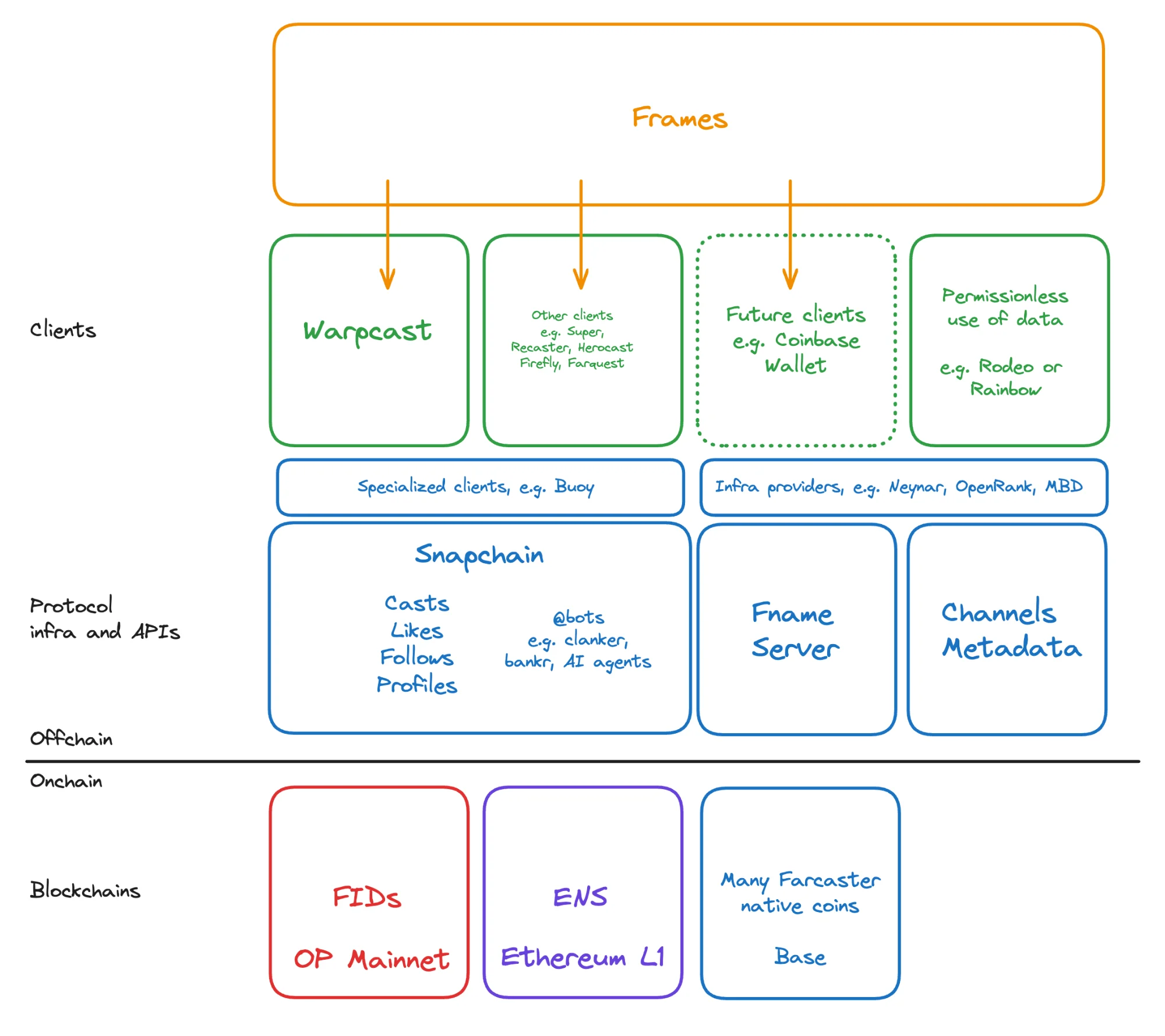
Dan Romero recently shared the ["Visualizing the Farcaster stack" diagram above](https://warpcast.com/dwr.eth/0x709365a2), and I think it serves as a great starting point to understand what the FarStack is. Let's work our way from the bottom to the top to illustrate what architecture holds up the experiences users see in apps such as Warpcast:
#### Blockchains
The FID(Farcaster ID) registry lives on OP Mainnet and ENS names, which are supported but not *required* by the protocol, live on the Ethereum L1(Mainnet). The other onchain aspect of the Farcaster ecosystem is the growing economy(or [Farconomy](https://dune.com/0xluc/farconomy) 😉) of Farcaster-native coins on Base. Warpcast and other apps have recently been leaning into the onchain nature of Farcaster's community through embedded/smart wallets, ticker pages in the social feed and and pushing transactions in Frames v2. What's unique both about Farcaster is how it makes blockchain interactions social by default, creating an environment where onchain activity feels like a natural extension of social engagement rather than a separate experience.
#### Protocol infra and APIs
At the core of Farcaster's infrastructure sits Snapchain—a blockchain-like network for storing and syncing social data that's being implemented to replace the previous Delta Graph system. Snapchain introduces transaction ordering and blockchain-like semantics to address consistency challenges faced as the network grew beyond thousands of nodes. When users create content or interact with others, they generate cryptographically signed messages that include their FID and a signature. These messages are grouped into ordered blocks, making synchronization between nodes much simpler and more reliable. This new approach enables stronger consistency guarantees while still supporting high throughput—designed to handle >9000 TPS, enough for 2 million daily active users.
What makes Snapchain different from traditional blockchains is that its transactions aren't Turing complete and are account-independent, focused specifically on social operations like posts and likes. This specialization allows for better scaling since it prevents the network from being used for non-social purposes and makes sharding by account straightforward. Older transactions are pruned to clear data from inactive users or negating transactions (like when a user likes and then unlikes something), keeping the network efficient.
The Fname Server complements this system by providing human-readable username resolution, connecting FIDs to ENS names and creating a unified identity layer across the ecosystem. The Channels metadata infrastructure makes it easier for clients to resolve data about channels, which are built on top of [FIP-2](https://github.com/farcasterxyz/protocol/discussions/71).
Specialized clients like [Buoy](https://buoy.club) provide targeted functionality for the ecosystem, serving specific developer needs beyond what general purpose clients offer. Meanwhile, infrastructure providers like [Neynar](https://neynar.com), [OpenRank](https://openrank.com), and [MBD](https://mbd.xyz) have become critical to the developer ecosystem by providing API layers that abstract away much of the protocol's complexity:
- **Neynar** offers comprehensive APIs and data products for reading and writing to Farcaster, user authentication via Sign in with Neynar (SIWN), bot creation tools, and much more.
- **OpenRank** provides specialized ranking algorithms and data indexing that help developers surface relevant content for their users.
- **MBD** delivers customizable feed generation services that enable cross-chain holistic user profiles and personalized content discovery.
This robust architecture combined with the rapidly growing ecosystem of developer tools has created a powerful foundation that even established teams are embracing. Neynar, OpenRank, MBD, and other infra providers now power many of the most popular teams building on Farcaster, abstracting away protocol complexity and enabling developers to build sophisticated experiences in a fraction of the time it would take otherwise. These providers have become so essential that they're now backed by major investors and serve as the backbone for both indie developers and well-funded teams looking to enter the Farcaster ecosystem.
#### Clients
The client layer is where users actually experience Farcaster, and the ecosystem has evolved far beyond a single app. Warpcast remains the flagship client created by the Merkle team (the team behind the protocol), offering a polished experience that has set user expectations. The open protocol approach has encouraged alternative clients to flourish—[Super](https://super.sc), [Recaster](https://recaster.org), [Herocast](https://herocast.xyz), and others each introducing new features and catering to different types of users.
Looking ahead, future clients like Coinbase Wallet could bring Farcaster to millions of mainstream users, while apps that integrate Farcaster's social graph into their features like Interface, Rodeo, and Rainbow demonstrate the power of permissionless data access without building full clients. This multi-client ecosystem ensures users can choose their preferred experience without sacrificing their social connections—a fundamental strength of Farcaster's open protocol design.
#### Frames
Sitting at the top of the FarStack, Frames v2 are Farcaster's exciting new platform of mini-apps that live directly in the client. Users can open frames either in a post or from a dedicated Frames page, and when opened frames let you see an entire webpage that has context to your Farcaster identity and social graph. Frames provide developers with access to user context, notifications, and access to the user's connected wallet.
What makes Frames v2 so powerful is how they completely reshape app distribution and discovery. Developers don't need to compete in crowded app stores or convince users to download another app—they can build experiences that spread naturally through social sharing, instantly reaching an engaged audience. Users simply tap a frame in their feed and immediately get an app-like experience with their Farcaster identity already connected, complete with wallet transactions, notifications, and other native features without any downloads or new accounts. This creates an unprecedented level of frictionless interaction that's spawning all kinds of creative applications—from games and utilities to commerce tools and financial apps—fundamentally changing what's possible inside social clients and potentially offering the breakthrough approach consumer crypto needs to reach mainstream users.
## How the FarStack came together
The FarStack didn't just appear overnight — it's the result of solid foundational work and years of growth both at the protcol and app level that pushed Farcaster's technical requirements forward.
The team wisely started by solving identity first. By anchoring IDs onchain but keeping the messages off-chain, they created a system that gives users true ownership without sacrificing the speed we expect from modern apps. Hubs (and now Snapchain) evolved as clever solutions for fast message propagation without constant blockchain transactions.
What I find most impressive about what we now call the FarStack is the response from the Farcaster developer community to make tools -- from docs to starter repos from language-specific libraries to entire developer platforms -- easier to use. All of this plus Farcaster-adjacent teams paying attention and finding smart ways to fit into developers' stacks(Base and Privy are great examples of this to me) has made the stack more all-encompassing, easier to use, and sometimes a bit much to keep up with because of how fast things are moving!
## Farcaster build season
We're definitely in "Farcaster build season" right now—a period where *serious* teams are committing real resources to building on the protocol. I'm seeing experienced founders and well-funded companies choosing Farcaster as their platform, which signals something important is happening for both the protocol and consumer crypto more broadly.
Two things in particular excite me about this Farcaster build season:
1) A plethora of different teams are building on Farcaster for different reasons, whether that's to strengthen something onchain, test out new ideas, or use the power of onchain and social to onboard/bring crypto to an entirely new set of people.
2) AI developer tooling and the number of developer resources overall in the FarStack are improving so much that it'll let even more people see firsthand the promise of building tools that have the net-new distribution that platforms like v2 frames give you.
This momentum is creating exactly the kind of virtuous cycle that keeps ecosystems like the FarStack's up and running: more apps → more users → more developers → more apps.
------------------------------------------------------------
## The Wallet Of Tomorrow - [/blog/the-wallet-of-tomorrow](/blog/the-wallet-of-tomorrow)
---
title: 'The Wallet of Tomorrow'
publishedAt: '2023-03-14'
summary: 'The Wallet of Tomorrow'
---
Wallets and accounts are key primitives in web3.
Although the terms "wallets" and "accounts" are vital components in the web3 landscape, their interchangeable usage can lead to confusion. Additionally, leading wallet platforms often lack user-friendly interfaces that clearly differentiate between the roles of wallets and accounts, creating further confusion. However, recent advancements in the Ethereum ecosystem, such as the introduction of account abstraction through ERC-4337, suggest that significant changes to wallets and accounts are on the horizon. What will these changes look like, and what implications will they have for users?
Crypto wallets store assets that are held on the blockchain. They can be used to buy and sell assets, as well as to interact with dApps for authentication or proof-of-identity. Each wallet holds a private key that it needs to function. This key can be used so that a wallet can be accessed from multiple places, but the interactions from those access points won’t sync. In addition, using a private key is a hassle and means that a central point of failure exists, creating a major security risk.
An account is also a place to store assets and interact with dApps, and it has its own public address for contract interaction. It can do the same things wallets can, except that the account's private key is connected to a wallet, as opposed to having its own separate key. This removes any security advantage of storing assets in multiple accounts, even though they have separate public addresses, as they're always tied back to a parent wallet.
Wallets and accounts have existed for a while and crypto has grown to a sizable scale with consumers using them, but the two still have some major issues that need to be fixed in order for the next billion users to be onboarded to crypto.
First, wallet apps don't implement consistent language or experiences for using wallets and accounts. For example, Coinbase lets you add wallets, MetaMask lets you add wallets or accounts, and Blockstream Green's accounts are groups for wallets. These are three very different experiences that _should_ feel almost identical across each app.

Second, there isn't one central identity manager that knows everything you're doing and allows you to move dApps, interactions, or tokens into groups. This inconsistency between apps around what wallets and accounts are limits how the user can control their digital identity.
The lack of user-friendly tools, coupled with the difficulty in understanding how to use them safely and securely, can make it difficult for people to trust crypto. This leads to a cycle where users are unable to benefit from all that crypto has to offer due its complexity.
However, there are signs that major shifts could come to wallets and accounts, mainly thanks to new advancements rolled out in ERC-4337. ERC-4337 lays out the idea of account abstraction (AA), which plans to help implement smart contract wallets in the place of seeded wallets.
Instead of using externally owned accounts (EOAs) such as MetaMask that are tied back to one seed phrase/key and require manual transactions in one place, AA lets users set permissions, batch transactions, and control more robust settings around account recovery. This means that instead of the functionality of wallets being a part of the bad UX, users can have much more robust settings and more trust that their wallets will be more safe/easy to use.
What could some of the most impactful use cases be? Here are a few that, paired with good design, could really help the flow of user activity.
- **Bundling Transactions**: Need to swap tokens before purchasing an NFT? Now you can get that all done in one transaction, saving gas and making the purchase more friction-less.
- **Social Recovery:** What if you get locked out of your wallet and a trusted account or friend could get you back in, without dealing with the mess of seed phrases? As Vitalik Buterin [explains in this article](https://vitalik.eth.limo/general/2021/01/11/recovery.html), smart accounts can help avoid that headache.
- **Self Custody:** Because of how much more web2-like account abstraction is making wallets, users can do more and more easily on/off-ramp, which adds to their security.
- **Session Keys:** Session keys allow users to pre-approve transactions given a set of its parameters. A great example of how this can be helpful is in a game, so users don't constantly have to approve transactions but can still be safe. They can also help enable subscriptions, which would allow many web3 companies to not only bring more users on-chain, but also to create a revenue stream. You can [learn more here](https://mirror.xyz/matchboxdao.eth/VXOvLKIvfXHP-cusKHw55zqlHpvvWwzh_fqm6j48Yek) in a great article by MatchboxDAO on the topic.
Developers are working on bringing these features to mainstream audiences. And to add more incentives, The Ethereum Foundation [announced $300K in grants for teams in the space](https://twitter.com/erc4337/status/1631087958949531648).
Here are a few teams to keep an eye out for 👀:
- [**Patch Wallet**](https://patchwallet.com)**:** A wallet where you log in with your GitHub/Twitter/Email, no seed phrases required. Patch works great for claiming airdrops and for attestation, as each login is verified and added to the wallet's profile.
- [**Stackup**](https://stackup.sh/)**:** Infrastructure for smart contract wallets. Developers can build their own wallets using ERC-4337, access bundlers & nodes, and sponsor gasless transactions.
- [**Argent**](https://www.argent.xyz/)**:** an account abstraction wallet on Ethereum. Argent features cheap transactions because of zkSync's L2 network, offers users yield options, and implements social wallet recovery.
- [**Starknet**](https://www.starknet.io/en)**:** smart contract wallet where transaction fees are paid by a specific token that the Starknet OS handles.
Some of the most skilled developers and teams are working on account abstraction. But from everything they’re doing, what should the result be that best benefits everyone in the ecosystem, and what could that result look like?
What if setting recurring payments for a subscription was as easy as Face ID-approval for a stablecoin transaction? Features like this would not only improve existing wallet UX, but also make experiences feel familiar enough for web2 users to join web3. Similarly, a third party can sponsor gas fees to ensure that apps are easier for users and require less friction.
[https://twitter.com/0xdesigner/status/1633122335866900480?s=46&t=8l54n7dYtHePgMrhGh-cUw](https://twitter.com/0xdesigner/status/1633122335866900480?s=46&t=8l54n7dYtHePgMrhGh-cUw)
The fundamental idea of this article is the importance of a seamless user experience in managing wallets and accounts. Rather than scattered across multiple apps, users should be able to manage their assets in one unified platform. If we don’t succeed in building a smooth user experience, then users will default to web2 systems.
One piece of infrastructure that I’m incredibly bullish on is [Wallet as a Service (WaaS) from Coinbase](https://www.coinbase.com/blog/coinbase-announces-wallet-as-a-service-now-any-company-can-seamlessly). The tool lets developers build web2-like experiences for their users, and uses advanced Multi-Party Computation(MPC) technology – tech that allows a wallet’s private key to be shared among multiple parties. With new custodial wallets and wallet solutions coming from tools like WaaS, [Magic Labs](https://magic.link), and others, it’s not hard to imagine a world where all login solutions use smart contract wallets behind the scenes.
As much as I want to see wallets evolve, one thing I really hope new wallets emphasize is more unified vocabulary. If certain features of a smart contract wallet seem universal and ways to group or manage those wallets do as well, then language shouldn't deter user activity.
[This Dune dashboard](https://dune.com/msilb7/Ethereum-Network-Participant-Ratios) highlights that Ethereum has around 2M wallets sending/receiving assets per week, while over 2BN+ use online banking per year, [according to Statista](https://www.statista.com/statistics/1228757/online-banking-users-worldwide/). If these stats mean one thing, it's that web3 hasn't matured yet.

In order for web3 to become mainstream, it's crucial that industry standards are agreed upon. ERC-4337 can help address wallet and account issues, and pave the way for a more standardized and accessible future of web3. Let's work together to onboard the next billion users 🚀
Interested in the future of wallets/accounts and want to talk? [Send me a DM on Twitter](https://twitter.com/Dylan_Steck) or [find me on Farcaster](https://warpcast.com/dylsteck).
------------------------------------------------------------
## Thoughts On Building A Farcaster Client - [/blog/thoughts-on-building-a-farcaster-client](/blog/thoughts-on-building-a-farcaster-client)
---
title: 'Thoughts on building a Farcaster client'
publishedAt: '2024-01-24'
summary: 'Some thoughts on building a Farcaster client after spending some time building my own web & mobile client, Litecast.'
---
I've been spending a lot more time lately building an open source Farcaster client called **[Litecast](https://litecast.xyz)**. I wanted to share some notes that have popped in my head as I've been in client-land:
**Building a Farcaster client is one of the highest leverage/highest impact things you can do in the ecosystem (*major bonus points for mobile dev't*)**
[Warpcast](https://warpcast.com) has the vast majority of client market-share and while there are more clients emerging, I'd argue that there aren't enough people competing directly with Warpcast. On top of this, the usage rates both for Warpcast and most apps in general are *significantly higher on mobile* ([Dan](https://warpcast.com/dwr.eth) even shared that something like ~85% of Twitter usage is on mobile, with [Warpcast sitting at 80% mobile usage](https://warpcast.com/dwr.eth/0x579aeaff)) -- yet Warpcast is the *only* Farcaster client in the Apple App Store & Google Play Store. Honestly, it's a bit shocking that Warpcast is the *only* real mobile client, especially given how much capital there is in the broader Farcaster ecosystem now.
Building a client not only supports the protocol overall, but it also:
- Lets you create the experience you want to: for example I want to add mini-apps and feel like Warpcast probably won't do that(at least soon), but I can bring that experience to others by building it
- Opens up more pockets of growth on the protocol that yourself and others can benefit from -- whether that results in venture rounds, new customers, or overall exposure
**The Farcaster developer community is still underserved for the amount of activity happening on the protocol**
There has been a bigger push over the past few months to improve the developer experience -- both from Warpcast themselves and others -- but I'd argue that it's not enough to attract more builders, or to incentivize those who are already Farcaster-native to build clients. In comparison, a developer on Bluesky/Mastodon/Lens(especially Lens) has access to *free resources from multiple data providers* that they can use to build their apps. I understand that businesses need to make money and also that decentralization/free access isn't the answer to every problem, but not having more of the Farcaster DevEx free & easy to use puts us in a state where the Farcaster ecosystem feels more like web2 and less interoperable.
Also this is more platform specific but I think a big focus here *needs* to be mobile. Even comparing how I built Litecast's web and iOS builds, I'm noticing how much quicker it was to build on the web vs. on mobile.
_Note:_ some of this isn't Farcaster specific(eg. I think hot reload is much faster on the web than in React Native), but I still think it's a problem worth noting
**There are *so* many areas that feel ripe for disruption/exploration on Farcaster, it almost feels endless**
For example, here are a few things that Litecast can do or serve as that nobody/a very limited number of people in the Farcaster ecosystem are doing:
- Integrate [Mod Protocol](https://www.modprotocol.org/)'s cast editor and mini apps
- Provide an open source template for building a cross-platform Farcaster client in React & React Native
- Hyper focus on every small detail in Litecast so the design and animations truly stand out like a web2 app that was put together by an agency
- Enable passkey authentication and more wallet/signer actions in-app like Warpcast does
And other than the fact that I personally like jumping from project to project, the main incentives that I have to build these things that are ripe for disruption are:
- Contribution -- building something that others would want to remix, whether that's for their own app or for Litecast
- Attribution -- being able to build up a track record of building cool tooling, which in my eyes can only lead to positive things(opportunities, exposure, etc)
- Personal use -- most of the time I start building something/working on a problem because it's genuinely interesting to me and I want to use a solution that's hyper-specific to my problem
- Gratitude/why not?! -- if I'm building something for myself and I know others can benefit from seeing how it works under the hood, why not let others benefit from it? It's the ethos of the community and feeds into everything else I listed above, plus it feels good to give back because of how much the community has done for me.
So while there might be other things in the world/professionally that I'm interested in, it's really easy for me to be fully fixated on the Farcaster ecosystem -- and most importantly it's always something that's exciting!
Anyways, this post isn't meant to be an update on where things are with Litecast or what's coming next -- maybe I'll write up a separate piece on that -- just some loose thoughts on my journey with Farcaster client development and the space as a whole. But if you want to learn more about Litecast in the meantime:
- Check out the [web version at litecast.xyz](https://litecast.xyz) and [view the code on GitHub](https://github.com/dylsteck/litecast-web)
- [Join the testing group for Litecast's TestFlight](https://warpcast.com/dylsteck.eth/0xc703c109) and [view the code on GitHub](https://github.com/dylsteck/litecast)
- Keep up with the latest on Litecast and my other projects by [following me on Farcaster](https://warpcast.com/dylsteck.eth)
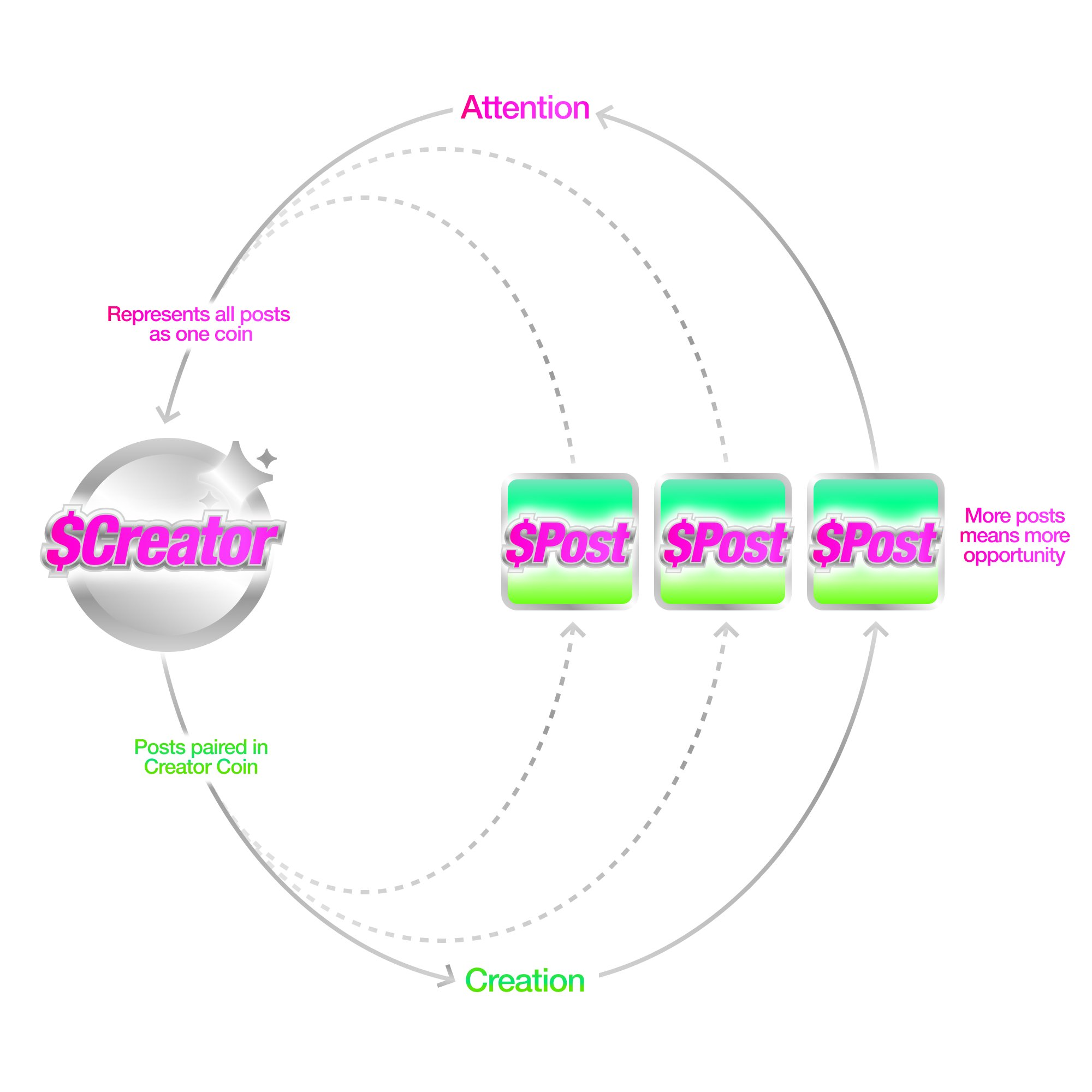 The creator coin thesis on its own is exciting in how it tries to help creators monetize and create larger fandom/markets, but where I think it gets even more exciting is around this idea of bringing your coin with you.
To me what this means is finding a set of apps where users can participate in an activity that somehow involves your coin: whether that's a router that has the lowest fees for swapping your coin, a game where you can pay with/use your coin somehow, a livestream where you can tip in the chat using a creator coin, and much more.
This is what Jesse's asking about in the post below and what I think will only continue to grow. It has implications for creators like Jesse and others, apps like [Bracky](https://bracket.game) or [Cody](https://codygame.com) or [Tortoise](https://tortoise.studio) and countless others that are making appcoins vital parts of their apps and even collabing with others, and even memecoins where people want to continue gathering around a larger community/trend.
[Cast: https://farcaster.xyz/jesse.base.eth/0x9c57972e]
Two things that stick out to me about building apps with this model:
- This paves a new way for creatives to collaborate with financial upside, you can figure out some model where an app/creator coin is used and both collaborators(eg. a creator and an app) benefit. This can even happen permissionlessly!
- Users become more invested in ecosystems where their coins work across multiple apps, creating natural retention loops and deeper engagement that benefit both users and app developers. This is also a great way for exsting coins to revitalize their communities.
It's been fun to watch this play out in real time. We're seeing creators launch coins, apps launch their own and integrate creator coins, and users start to use these coins across platforms. The 'bring your coin with you' model isn't fully formed yet, but the direction feels right and the early examples are already showing why it matters.
---
**Edit:** I know this isn't about creator coins but about a NFT collection, but there's a related example that's great and I wanted to highlight. [Sayangel](https://farcaster.xyz/sayangel) launched the [Warplets NFT project/miniapp/universe](https://www.warplets.ai) recently, which stemmed from a viral meme about Farcaster's embedded wallet and led to this massively viral project and even Farcaster Pro growth. Not only was there a combo about this mini app that led to it going super viral basically overnight, but it also opened this larger "Warplets universe"(for lack of a better term) where the Warplet is a character that all of these downstream apps are building on top of. While again this isn't necessarily a creator coin, I think it certainly falls in this bucket of a community coming around assets and content -- and doing so in a way that's composable across apps(eg. Warplet as this character that travels with you). Below is an overview of Warplets and this viral loop from [Linda](https://farcaster.xyz/linda)'s recent talk about Farcaster at Devconnect.
[Cast: https://farcaster.xyz/linda/0x0ab01492]
------------------------------------------------------------
## Building A Digital Garden - [/blog/building-a-digital-garden](/blog/building-a-digital-garden)
---
title: 'Building a Digital Garden'
publishedAt: '2023-02-10'
summary: 'Building a Digital Garden'
---

I’m excited to finally announce a project I’ve had in the works for a while — [my own digital garden.](https://dylansteck.com) This site holds my articles, casts from Farcaster, and tweets. As I write more, it will also contain more informal content such as thoughts(shorter writing), lists(of my favorite finds), NFTs, projects, and more. I’ve always wanted a tool that had all of my online content and identities in one place.
[Digital gardening](https://maggieappleton.com/garden-history) refers to building a site with notes and other inter-linking content that can be added to and updated over time. Some of my favorite online researchers and thinkers have built digital gardens as ways to share their thoughts, and their work has always inspired me to build my own. I’ve also wanted to share even more of my interests and beliefs, especially as it relates to technology and web3, and I think building a digital garden I can continually refer to is a great way to do so.
I want to share the process behind building this digital garden to help others who might want to create their own digital garden, as well as to highlight some potential updates(and opportunities) I’m thinking of.
## The Process
When I set off, I wanted to build a **decentralized** digital garden — or at least as close as I could get. The more I looked into this, the more improbable it looked to make the tool fully decentralized. To name a few key reasons why I chose this:
1. [Fleek](https://fleek.co) is a great tool but I’m not sure how well it handles edge functions, which I rely on in Vercel/Next.js
2. I can take my notes in [Obsidian](https://obsidian.md), upload them to GitHub, and then load them into my digital garden with very minimal effort and no changes to my workflow. [Arweave](https://arweave.org) or any other solution would’ve added more hassle and I rather stick to a system that feels better overall — especially one that lets me write in my favorite note taking tool.
3. Because of how much content I have in my feed(and because Twitter’s API is about to shut down free access so I wanted to have content backed up), I need to use a database — I use [Supabase](https://supabase.com) and it’s great. There’s not a decentralized storage solution that I feel very confident and comfortable with, and until that happens I rather stick with a more traditional stack, even if it’s not decentralized.
With these decisions made, I went ahead and started building. I had settled on a design for a while and just needed to implement it. The first page I built was the articles page because I wanted to make sure my Obsidian files were properly formatted, and that I could make changes to the files without messing up the site(see here: [example snippet on grabbing files from a GitHub repo](https://gist.github.com/dylsteck/4b2e7e72457e9d5f94e31a8c29a57d09)).
The next thing I did was set up access to the Twitter and Farcaster APIs. While connecting to Twitter was alright, setting up the [Farcaster API](https://api.farcaster.xyz/docs) was a _breeze_. The developer community is super easy to get in touch with and the fact anyone can use their API means some of the most interesting minds in web3 are coming and building cool things. I knew I wanted to add my casts to my site, since Farcaster has become a big part of my web3 identity. I’ve been using the platform much more than Twitter for several months now.

I always knew I wanted to set up a database, because it would make sense to backup data and have one place to grab data instead of calling several APIs every time someone loaded the site. However, I was being lazy setting one up until I got the new that Twitter was planning on restricting free access. I wanted to make sure that I could use the API to save all my tweets, and then once API access cuts off I’ll build another solution that uses web scraping. The last piece of backend architecture I needed to set up were a set of Vercel Edge Functions that will fetch new tweets/casts and save them to my database and I was all set to finish the user interface.
One of the most difficult things for me to set up was mobile responsiveness, something I find super important when building any site. So many people click on links on mobile that any web developer needs to optimize for that platform. Because of the homepage set up, I have two horizontal columns that I need to turn into rows on mobile. Making sure I had the right margins and everything set up took a while, but it was very rewarding to re-solidify skills on some intricate problems.
## Future Plans
Right now, the site holds three data types: **Articles**, **Casts**, and **Tweets**. In the very near future, I have plans to add four more data types:
- **Thoughts**: shorter and more loosely edited ideas that pop into my mind, but might be a bit too long to put on Farcaster/Twitter
- **Lists:** collections of different types of things I find, both to live on its own and also to be embedded in future articles
- **Projects**: what I’ve worked on that’s on my resume, as well as what’s on my online/on-chain resume
- **NFTs:** mints, sales, auction bids, and transfers from [my main wallet](https://rainbow.me/dylsteck.eth)
At the end of the day, the more I can add to [this digital garden](https://dylansteck.com) that is representative of myself, the better. I’m still actively brainstorming ideas so if anything sticks out to you, [let me know](https://nf.td/dylan)!
------------------------------------------------------------
## Cortex One Pager - [/blog/cortex-one-pager](/blog/cortex-one-pager)
---
title: 'Cortex One Pager'
publishedAt: '2024-09-04'
summary: 'I'm building a new product called Cortex, Notion-style blocks for Farcaster data. Below is a one-pager on the concept and its progress.'
---
I'm building a new product called [Cortex](https://withcortex.com), Notion-style blocks for Farcaster data. Below is a one-pager on the concept and its progress:
### Motivation
As [Farcaster](https://farcaster.xyz) has grown, the amount of data tied to your profile has expanded. It’s no longer limited to just hub data -- now there's data from several ecosystem apps such as [Eventcaster](https://events.xyz) for events, [Bountycaster](https://bountycaster.xyz) for bounties, [Zora](https://zora.co) for mints, [Icebreaker](https://icebreaker.xyz) for connections, [Paragraph](https://paragraph.xyz) for articles, [Receipts](https://receipts.xyz) for workouts, [Unlonely](https://unlonely.app) for streams, and more. This data is scattered across different platforms, making it challenging for users to manage or interact with it in a cohesive way.
There’s a growing demand for better composability and interoperability between these apps. Many developers have stepped back from building full Farcaster clients because the ecosystem is fragmented or too niche to offer immediate business opportunities. However, there’s still a strong need for tools that enable users to make better use of their personal Farcaster data, even if they don’t want to commit to building entire clients.
Currently, apps like [Warpcast](https://warpcast.com) promote other apps through the Explore tab and experiment with different surfaces areas for apps(including composer actions and frames), but they don’t serve as a unified home for managing data and actions across these apps. What’s missing is an interface that can act as both a library for data and a place to execute actions, similar to how an operating system provides unified control across services.
For a focused community like Farcaster’s, having more seamless access to and integration between these data sources could greatly enhance user experience and productivity. As the ecosystem continues to grow, the need for tools that provide a more unified and composable way to engage with Farcaster data is becoming increasingly evident. By offering a central interface to manage and interact with this data, workflows would be streamlined, enabling users to fully capitalize on the ecosystem’s expanding potential.
### Concept
I've started building a set of **Notion-style blocks** designed for interacting with Farcaster-related data. They'll range all the way from Farcaster components like feeds, profiles, and frames to Icebreaker profile content to Zora mints to DAO auctions to composer actions or other embeddable mini-apps. The hope is that if I can create blocks that span enough use cases that I can test out a set of different interfaces that would make best use of these blocks.
### Experiments
The first experiment I'm building was inspired by [a cast from Dan Romero about an idea](https://warpcast.com/dwr.eth/0xc05b0d94) for a Chrome extension that could show top Farcaster content in a sidebar. Inspired by that cast and [a 30 minute experiment I ran after reading it](https://warpcast.com/dylsteck.eth/0xa5290dba), I'm going to make a Chrome sidepanel extension that lets you vertically stack these blocks as if they're widgets. If you're a macOS user, imagine the widget stacking on your right sidebar but in your browser and filled with Farcaster-related data.
I want to center my attention on testing a small number of things in the first experiment so I can use whatever goes well to keep moving forward, but there are also certainly other experiment ideas I'm super excited to get to.
The main idea I want to get to and am bullish on with these blocks is a [v0.dev](https://v0.dev) or [Claude Artifacts](https://claude.ai)-style tool that can generate fully new Farcaster mini-apps with these blocks. Not only do I think that the underlying tech is getting so much better to the point where this is feasible, but I also think being able to type in suggestions/commands is a much more intuitive way to make or do something.
### Next Steps
I'm hoping to get my first experiment(the Chrome sidepanel extension) out within the next week or so and I've also created this group chat where I'll be sharing progress & having conversations with those interested in the project -- feel free to [join here on Warpcast!](https://warpcast.com/~/group/CZHFhJi6dSfW8mw2PKi1RQ)
------------------------------------------------------------
## Crypto Super App - [/blog/crypto-super-app](/blog/crypto-super-app)
---
title: 'Crypto Super App'
publishedAt: '2024-05-18'
summary: 'Why everyone wants it but nobody is building it'
---
If you're in crypto or spend time on platforms like [Farcaster](https://farcaster.xyz), you might've heard folks talk about the idea of a crypto super app -- the industry's (hypothetical) equivalent of a [WeChat](https://wechat.com)-like app that contains a bunch of mini programs that the user can use without leaving the super app. This app's "user profile" would be a wallet(or collection of wallets), social graphs would be automatically imported from protocols like Farcaster or [Lens](https://lens.xyz), and crypto-enabled features would just feel built in(copy an action from your group chat, connect your wallet anywhere, tip crypto in a livestream, mint a NFT, etc). However, there's one big problem with this idea: **everyone wants it but nobody is building it.**
## Super Apps
Super apps in general are part of the past decade's "SaaS Bundling", where companies try to build business in multiple verticals that are inter-connected and capture as much value as they can from their customers. In essence, it's each company's attempt at not only expanding their businesses, but also at creating a walled garden that makes their customers' time(and information) with their services more valuable.
The creator coin thesis on its own is exciting in how it tries to help creators monetize and create larger fandom/markets, but where I think it gets even more exciting is around this idea of bringing your coin with you.
To me what this means is finding a set of apps where users can participate in an activity that somehow involves your coin: whether that's a router that has the lowest fees for swapping your coin, a game where you can pay with/use your coin somehow, a livestream where you can tip in the chat using a creator coin, and much more.
This is what Jesse's asking about in the post below and what I think will only continue to grow. It has implications for creators like Jesse and others, apps like [Bracky](https://bracket.game) or [Cody](https://codygame.com) or [Tortoise](https://tortoise.studio) and countless others that are making appcoins vital parts of their apps and even collabing with others, and even memecoins where people want to continue gathering around a larger community/trend.
[Cast: https://farcaster.xyz/jesse.base.eth/0x9c57972e]
Two things that stick out to me about building apps with this model:
- This paves a new way for creatives to collaborate with financial upside, you can figure out some model where an app/creator coin is used and both collaborators(eg. a creator and an app) benefit. This can even happen permissionlessly!
- Users become more invested in ecosystems where their coins work across multiple apps, creating natural retention loops and deeper engagement that benefit both users and app developers. This is also a great way for exsting coins to revitalize their communities.
It's been fun to watch this play out in real time. We're seeing creators launch coins, apps launch their own and integrate creator coins, and users start to use these coins across platforms. The 'bring your coin with you' model isn't fully formed yet, but the direction feels right and the early examples are already showing why it matters.
---
**Edit:** I know this isn't about creator coins but about a NFT collection, but there's a related example that's great and I wanted to highlight. [Sayangel](https://farcaster.xyz/sayangel) launched the [Warplets NFT project/miniapp/universe](https://www.warplets.ai) recently, which stemmed from a viral meme about Farcaster's embedded wallet and led to this massively viral project and even Farcaster Pro growth. Not only was there a combo about this mini app that led to it going super viral basically overnight, but it also opened this larger "Warplets universe"(for lack of a better term) where the Warplet is a character that all of these downstream apps are building on top of. While again this isn't necessarily a creator coin, I think it certainly falls in this bucket of a community coming around assets and content -- and doing so in a way that's composable across apps(eg. Warplet as this character that travels with you). Below is an overview of Warplets and this viral loop from [Linda](https://farcaster.xyz/linda)'s recent talk about Farcaster at Devconnect.
[Cast: https://farcaster.xyz/linda/0x0ab01492]
------------------------------------------------------------
## Building A Digital Garden - [/blog/building-a-digital-garden](/blog/building-a-digital-garden)
---
title: 'Building a Digital Garden'
publishedAt: '2023-02-10'
summary: 'Building a Digital Garden'
---

I’m excited to finally announce a project I’ve had in the works for a while — [my own digital garden.](https://dylansteck.com) This site holds my articles, casts from Farcaster, and tweets. As I write more, it will also contain more informal content such as thoughts(shorter writing), lists(of my favorite finds), NFTs, projects, and more. I’ve always wanted a tool that had all of my online content and identities in one place.
[Digital gardening](https://maggieappleton.com/garden-history) refers to building a site with notes and other inter-linking content that can be added to and updated over time. Some of my favorite online researchers and thinkers have built digital gardens as ways to share their thoughts, and their work has always inspired me to build my own. I’ve also wanted to share even more of my interests and beliefs, especially as it relates to technology and web3, and I think building a digital garden I can continually refer to is a great way to do so.
I want to share the process behind building this digital garden to help others who might want to create their own digital garden, as well as to highlight some potential updates(and opportunities) I’m thinking of.
## The Process
When I set off, I wanted to build a **decentralized** digital garden — or at least as close as I could get. The more I looked into this, the more improbable it looked to make the tool fully decentralized. To name a few key reasons why I chose this:
1. [Fleek](https://fleek.co) is a great tool but I’m not sure how well it handles edge functions, which I rely on in Vercel/Next.js
2. I can take my notes in [Obsidian](https://obsidian.md), upload them to GitHub, and then load them into my digital garden with very minimal effort and no changes to my workflow. [Arweave](https://arweave.org) or any other solution would’ve added more hassle and I rather stick to a system that feels better overall — especially one that lets me write in my favorite note taking tool.
3. Because of how much content I have in my feed(and because Twitter’s API is about to shut down free access so I wanted to have content backed up), I need to use a database — I use [Supabase](https://supabase.com) and it’s great. There’s not a decentralized storage solution that I feel very confident and comfortable with, and until that happens I rather stick with a more traditional stack, even if it’s not decentralized.
With these decisions made, I went ahead and started building. I had settled on a design for a while and just needed to implement it. The first page I built was the articles page because I wanted to make sure my Obsidian files were properly formatted, and that I could make changes to the files without messing up the site(see here: [example snippet on grabbing files from a GitHub repo](https://gist.github.com/dylsteck/4b2e7e72457e9d5f94e31a8c29a57d09)).
The next thing I did was set up access to the Twitter and Farcaster APIs. While connecting to Twitter was alright, setting up the [Farcaster API](https://api.farcaster.xyz/docs) was a _breeze_. The developer community is super easy to get in touch with and the fact anyone can use their API means some of the most interesting minds in web3 are coming and building cool things. I knew I wanted to add my casts to my site, since Farcaster has become a big part of my web3 identity. I’ve been using the platform much more than Twitter for several months now.

I always knew I wanted to set up a database, because it would make sense to backup data and have one place to grab data instead of calling several APIs every time someone loaded the site. However, I was being lazy setting one up until I got the new that Twitter was planning on restricting free access. I wanted to make sure that I could use the API to save all my tweets, and then once API access cuts off I’ll build another solution that uses web scraping. The last piece of backend architecture I needed to set up were a set of Vercel Edge Functions that will fetch new tweets/casts and save them to my database and I was all set to finish the user interface.
One of the most difficult things for me to set up was mobile responsiveness, something I find super important when building any site. So many people click on links on mobile that any web developer needs to optimize for that platform. Because of the homepage set up, I have two horizontal columns that I need to turn into rows on mobile. Making sure I had the right margins and everything set up took a while, but it was very rewarding to re-solidify skills on some intricate problems.
## Future Plans
Right now, the site holds three data types: **Articles**, **Casts**, and **Tweets**. In the very near future, I have plans to add four more data types:
- **Thoughts**: shorter and more loosely edited ideas that pop into my mind, but might be a bit too long to put on Farcaster/Twitter
- **Lists:** collections of different types of things I find, both to live on its own and also to be embedded in future articles
- **Projects**: what I’ve worked on that’s on my resume, as well as what’s on my online/on-chain resume
- **NFTs:** mints, sales, auction bids, and transfers from [my main wallet](https://rainbow.me/dylsteck.eth)
At the end of the day, the more I can add to [this digital garden](https://dylansteck.com) that is representative of myself, the better. I’m still actively brainstorming ideas so if anything sticks out to you, [let me know](https://nf.td/dylan)!
------------------------------------------------------------
## Cortex One Pager - [/blog/cortex-one-pager](/blog/cortex-one-pager)
---
title: 'Cortex One Pager'
publishedAt: '2024-09-04'
summary: 'I'm building a new product called Cortex, Notion-style blocks for Farcaster data. Below is a one-pager on the concept and its progress.'
---
I'm building a new product called [Cortex](https://withcortex.com), Notion-style blocks for Farcaster data. Below is a one-pager on the concept and its progress:
### Motivation
As [Farcaster](https://farcaster.xyz) has grown, the amount of data tied to your profile has expanded. It’s no longer limited to just hub data -- now there's data from several ecosystem apps such as [Eventcaster](https://events.xyz) for events, [Bountycaster](https://bountycaster.xyz) for bounties, [Zora](https://zora.co) for mints, [Icebreaker](https://icebreaker.xyz) for connections, [Paragraph](https://paragraph.xyz) for articles, [Receipts](https://receipts.xyz) for workouts, [Unlonely](https://unlonely.app) for streams, and more. This data is scattered across different platforms, making it challenging for users to manage or interact with it in a cohesive way.
There’s a growing demand for better composability and interoperability between these apps. Many developers have stepped back from building full Farcaster clients because the ecosystem is fragmented or too niche to offer immediate business opportunities. However, there’s still a strong need for tools that enable users to make better use of their personal Farcaster data, even if they don’t want to commit to building entire clients.
Currently, apps like [Warpcast](https://warpcast.com) promote other apps through the Explore tab and experiment with different surfaces areas for apps(including composer actions and frames), but they don’t serve as a unified home for managing data and actions across these apps. What’s missing is an interface that can act as both a library for data and a place to execute actions, similar to how an operating system provides unified control across services.
For a focused community like Farcaster’s, having more seamless access to and integration between these data sources could greatly enhance user experience and productivity. As the ecosystem continues to grow, the need for tools that provide a more unified and composable way to engage with Farcaster data is becoming increasingly evident. By offering a central interface to manage and interact with this data, workflows would be streamlined, enabling users to fully capitalize on the ecosystem’s expanding potential.
### Concept
I've started building a set of **Notion-style blocks** designed for interacting with Farcaster-related data. They'll range all the way from Farcaster components like feeds, profiles, and frames to Icebreaker profile content to Zora mints to DAO auctions to composer actions or other embeddable mini-apps. The hope is that if I can create blocks that span enough use cases that I can test out a set of different interfaces that would make best use of these blocks.
### Experiments
The first experiment I'm building was inspired by [a cast from Dan Romero about an idea](https://warpcast.com/dwr.eth/0xc05b0d94) for a Chrome extension that could show top Farcaster content in a sidebar. Inspired by that cast and [a 30 minute experiment I ran after reading it](https://warpcast.com/dylsteck.eth/0xa5290dba), I'm going to make a Chrome sidepanel extension that lets you vertically stack these blocks as if they're widgets. If you're a macOS user, imagine the widget stacking on your right sidebar but in your browser and filled with Farcaster-related data.
I want to center my attention on testing a small number of things in the first experiment so I can use whatever goes well to keep moving forward, but there are also certainly other experiment ideas I'm super excited to get to.
The main idea I want to get to and am bullish on with these blocks is a [v0.dev](https://v0.dev) or [Claude Artifacts](https://claude.ai)-style tool that can generate fully new Farcaster mini-apps with these blocks. Not only do I think that the underlying tech is getting so much better to the point where this is feasible, but I also think being able to type in suggestions/commands is a much more intuitive way to make or do something.
### Next Steps
I'm hoping to get my first experiment(the Chrome sidepanel extension) out within the next week or so and I've also created this group chat where I'll be sharing progress & having conversations with those interested in the project -- feel free to [join here on Warpcast!](https://warpcast.com/~/group/CZHFhJi6dSfW8mw2PKi1RQ)
------------------------------------------------------------
## Crypto Super App - [/blog/crypto-super-app](/blog/crypto-super-app)
---
title: 'Crypto Super App'
publishedAt: '2024-05-18'
summary: 'Why everyone wants it but nobody is building it'
---
If you're in crypto or spend time on platforms like [Farcaster](https://farcaster.xyz), you might've heard folks talk about the idea of a crypto super app -- the industry's (hypothetical) equivalent of a [WeChat](https://wechat.com)-like app that contains a bunch of mini programs that the user can use without leaving the super app. This app's "user profile" would be a wallet(or collection of wallets), social graphs would be automatically imported from protocols like Farcaster or [Lens](https://lens.xyz), and crypto-enabled features would just feel built in(copy an action from your group chat, connect your wallet anywhere, tip crypto in a livestream, mint a NFT, etc). However, there's one big problem with this idea: **everyone wants it but nobody is building it.**
## Super Apps
Super apps in general are part of the past decade's "SaaS Bundling", where companies try to build business in multiple verticals that are inter-connected and capture as much value as they can from their customers. In essence, it's each company's attempt at not only expanding their businesses, but also at creating a walled garden that makes their customers' time(and information) with their services more valuable.